


This is the fifth (and, for now, final) chapter of The Ink’s series The Epstein Class — our investigation into the inner workings of Jeffrey Epstein’s world and the operating system of power today. For more:
The first chapter: Epstein’s network of bystanders, on courage in an age of networks
The second chapter: Never eat with women, on how Epstein’s circle avoided what it feared most
The third chapter: Rich Brain, on the mundanities that preoccupy the ultrawealthy
The fourth chapter: The most overlooked Epstein email, on a philosopher, a pedophile, and Epstein’s mind harem
To support independent journalism like this, become a subscriber:
The Epstein Class’s secret weapon

Already, it feels like the world has moved on.
There was a dark shining moment when all the world, it seemed, was focused on the crimes and schemes of Jeffrey Epstein and his coterie of associates and enablers. And then new stories vied for attention: a war broke out, human beings circled the moon, Kim Kardashian was spotted with Lewis Hamilton, memories faded, and the virus of collective rage went hunting for new hosts.
Was the Epstein story just another story? Was it just more grist for the mill? Was it a chance to vent the frustrations of an age in which some get away with anything they do and others never get anything they need? Will we take this phenomenon of a story as a spur to charting a new course — or “enjoy” the catharsis of fury and move on?
As I reflect on what I’ve learned spending time in this muck and putting together this series, two broad themes stand out; I believe our responses to each of them will help determine which way we will go. One is the culture of impunity, of a lack of accountability, that the Epstein saga highlights but that is endemic far beyond it. The other is the opiate of tribalism that allows the impunity at the top to go on.
This has been an era of infinite second chances at the top, facilitated by an underlying solidarity, and of fewer and fewer first chances for everyone else, exacerbated by their inextinguishable hostilities. Mostly, the Epstein files are an education in how not to be. But if we want to change this dismal status quo, we have to do something that I generally don’t advise: learn from the Epstein class. That’s because on one point, at least, this network is actually worth emulating.
They always have each other’s backs.

When Epstein was accused of sex crimes involving minors in 2007, he built a legal team and fought the charges. The following year, as later laid bare by Julie Brown’s heroic reporting in the Miami Herald, he secured a sweetheart deal that required him to serve just over a year in prison. Except that it wasn’t really prison: Epstein finagled a work-release allowance that let him come and go and allegedly put in time at a nonprofit. A local news outlet that obtained logs of his movements while “imprisoned” reported that Epstein was “[p]icked up by his private driver in a limo and allowed to make stops at his own home,” that he was permitted by a judge “to leave his cell six days a week,” that he was assigned a kind of police detail that “took him to his house at least nine times while he was on work release, and left him in his home unsupervised for up to three hours.” At one point, a confused police officer asked a sergeant for “some clarity of my duties and responsibilities while at the residence.” The sergeant reportedly answered that the officer’s function was to “provide security” for Epstein. Against the public, not the other way around.
So at the heart of this story is a galling impunity. But in this as in other ways, our principal character’s way of moving through the world was not unconnected to the ways of the larger circle that surrounded him.
One of Epstein’s lawyers in the matter, the late Kenneth Starr, had spent much of the 1990s hounding President Bill Clinton for sexual misconduct, wasting vast sums of public money on a political witch hunt and destroying lives in the process. Now, in 2007, Starr signed on to Epstein’s legal team, becoming an avid defender of a Clinton friend’s considerably worse sexual misconduct. This is how it works in this world: you never have to take a beat and say, I was wrong. You just move on to the next thing.
The doom loop of causing problems, ducking accountability, and even being promoted is a defining feature of this circle. Larry Summers pushed for financial deregulation under Clinton, and when, in 2008-9, thanks to advice of that kind, the markets melted down and the world economy collapsed, he was brought in as a top economic advisor to President Barack Obama. Bill Gates operated a monopoly that crushed competition (which is to say other people’s dreams), reaped a fortune anyway, and parlayed it all into an even more august position as unofficial global health czar.
As David Sirota has argued unflaggingly, the lack of accountability for anyone at the top has become a driving force of this American age. Helped cause Iraq? Cable gig for you! Helped ignore Katrina? Professorship! Pushed subprime mortgages? Cabinet position! Built a tech behemoth that hurts kids? Presidential advisory commission!
In the Epstein class and far beyond it, across the commanding heights of American life, the best way to get ahead is to really majorly fuck something up along the way.
Why does our society function as a protection racket for elites who have made it big by making big mistakes, even as it becomes less merciful to everyone else? One answer that emerges from the Epstein files is that the super-elites who are all over it have a loyalty to each other that transcends opinions. They are connected on the basis of their interests, not their beliefs, and quite willing to sacrifice these “beliefs” on the altar of their interests. And this gives them a certain undergirding of compassion for each other, helpfulness to each other, that endures regardless of which way any given election goes, which ideological currents are ebbing and flowing, who is up or down.
One of my “favorite” emails is among the more indecipherable of the lot. The subject line is simply “list for bannon steve.” It says:
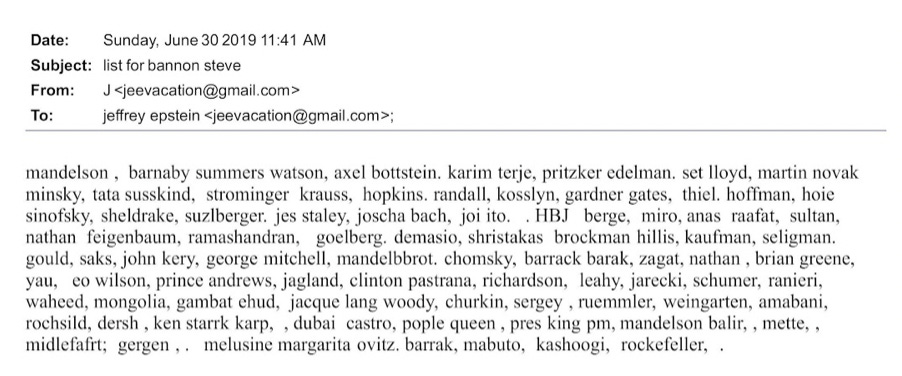
Who knows what this list was about. But it brings together people, many of whom were known to be in Epstein’s orbit, who don’t share a philosophy or race or religion or profession, but a membership: they are on a list of people who are on the list.
And what you see in the Epstein files is that people on the list generally treat each other as though deserving of brotherhood. Their elevation of network solidarity over principles and beliefs gives a resiliency and flexibility and even gentleness to the group. There is a moment in which Epstein appears to invite Kathy Ruemmler, a former White House counsel to President Obama, to join him on some panel (the exact details are not clear), along with Trump strategist Steve Bannon, Ehud Barak, the former Israeli prime minister, and former President Clinton. Epstein assures Ruemmler the event would be “off the record” and the collaboration “very funny.”
The email captures something important. Out there, in the world, these people have serious-seeming beefs with each other. But off the record, it’s all very chill — kind of funny, even. For people in the network don’t stress about their beliefs, no matter how publicly proclaimed. Beliefs, in fact, are often mere performance, and these elites, with their solidarity for each other, never forget that. Another of the exchanges that has stayed with me is between Epstein and Bannon about getting an Epstein friend into the Augusta National Golf Club. The friend is the super-lawyer Brad Karp, then running the white-shoe law firm Paul, Weiss. Karp had reportedly been a financial bundler for Democrats, and Paul, Weiss is known for its ties to the Democratic Party. But Epstein thinks nothing of asking Bannon for help getting Karp into Augusta.
Bannon’s first response is: “Can he convert to Southern Baptist???”
Karp is Jewish. Epstein attempts a joke: “Difficult to put the foreskin back on.”
Bannon then explains that Augusta historically was strict about “no catholics, Jews, blacks or women.” But Bannon seems determined to try — not because he and Karp agree on the issues but, one assumes, because they are ultimately on the same team.
Epstein asks who runs Augusta.
“These are real crackers,” Bannon writes. “7 Atlanta and Augusta families.” And then he adds, in case he has been too subtle: “Real crackers.”
So here we have the political figure who has done as much as anyone in America to revive white nationalism and populist fury referring to exclusionary white people in Georgia by the racist term “crackers.” It’s all a game — not the golf, but the republic itself. And then, in the early months of the second Trump term, Trump came after big law firms like Paul, Weiss, threatening to sever their government contracts if they didn’t come to heel, and, matching the spirit of flexibility Bannon had displayed, Karp bent — bent the knee and forever bent his law firm’s credibility. For many (including within the firm itself), it was an unconscionable capitulation. But the people who think that way are burdened by beliefs that depress their side of the seesaw. It’s why they may never find themselves at the very top, where beliefs are featherweight.
It’s not that members of the Epstein Class don’t possess beliefs. It’s that they seem to treat them, well, like that: as possessions. Their beliefs are tools to help them win; if they don’t continue to spark the joy of winning, throw them out. There can always be new beliefs; but the network is forever.
We down here, on the other hand — well, that’s a different story. We down here are at each other’s throats. This is the age of division, the age of polarization, the age of civic fracture…the age of impending civil war?
And what does this consist of, in practice? People who vote differently but share, more or less, similar interests becoming convinced that the neighbor two doors down is a mortal enemy. His vote is literally violence. Their protest is literally anarchy.
People without much power beyond their vote have become so convinced that other people without much power are their problem that it can be provocative to even suggest to some activists that they woo voters to their side in order to win elections. Why should they have to engage with such toxicity? On the right and left both, you will find fantasies of elimination — which is to say, the dream of living in a country cleansed of these different-thinking people.
In other words, among regular people, beliefs have been elevated over interests. Who you voted for has come to matter more than how you live. Ideology has superseded materiality, and so there is none of the suspension of judgment we see in the Epstein class. There is none of the bracketing. There is none of the tabling of this issue we don’t agree on in order to advance on that thing. No, down here, everything is war, and there is no give, and there is no mercy, and there is a dearth of genuine solidarity.
Is this, in the end, what we might learn from the Epstein files? That these people do their kabuki fighting in public and have each other’s backs in private when shit gets real; and we live lives with many of the same challenges but imagine our neighbors to be as bloodthirsty and ignorant of the world as an uncontacted tribe of cannibals. Nothing can reach those dolts; they are who they are; nothing will ever change their mind. We have none of the sense of mercy for each other that the Epstein class displays for its own. That mercy, in their case, comes from class solidarity; it comes from the solidarity of patriarchy. And in their abiding mutual support, they encourage us, through the media organs they own, through the social media platforms whose algorithms they code, through the political levers they operate, to keep bickering.
Our tribalism protects their impunity. Their solidarity sustains our being deprived of nice things that we could very easily have. Their ability to hold their beliefs lightly, and to take their own interests, on the other hand, very, very seriously indeed — this ability explains a lot about the society we live in. And it raises the question of what the world would look like if we beat them at their own game. If, instead of Bannon and Karp being the ones to battle on the surface and help each other below, it was us, that we held our noses at differences in our ranks, endured people who say things that sting, had tolerance for different locations on the on-ramp to change, but in some basic and fundamental way elevated our shared interests over our clashing beliefs.
On good days, you can see glimpses of it. In New York, Mayor Zohran Mamdani is doing more than bringing a leftist approach to governance. In ways that have not been properly appreciated, I think, he seems to aspire to a formation of the political left more interested in finding converts than heretics, more smiling than judging, more interested in mercy and expansion. It is an approach less interested in the dividing lines of identity and more interested in the binding agents of solidarity and shared hardship. His culture war is filling potholes.
It is one model in one place. We will see how many others of us can absorb these lessons. But this is what I am left with. In these Epstein files, we got an ugly and at times evil master class in elite solidarity. The ball of change is now in our court.
At The Ink, we work for you. When you join us, you stand up for independent media that isn’t afraid to tell the truth. Subscribe today and help us keep the lights on, pay our writers and editors a fair wage, reach more people, and build the kind of media that you want to read.
Anand, the Epstein class doesn't need beliefs because they have everything. The only threats to them are natural disasters, health issues, and the prospect of prosecution, and so far they've managed to buy their way out of two of those. In other words, they don't need to think. That's certainly not the way I want to live. I don't envy them at all. But I do get your advice that the rest of us should pull together. I'm happy to as long as we can all respect each other.
Definitely. I'm glad you mentioned David Sirota. I think his Master Class podcast especially about the Powell Memo comes into play here. The machinations behind the scenes in the 1970's greased the skids for Epstein, et al.
I'm not going to let go of this issue, so don't any of you reading, either. I'm actually in the studio recording a new song called, "Blow the Whistle."
I'm sick of the patriarchy ruining everything. Why not a matriarchy? I've watched too many shows about Elephants to believe men running everything is the way to go.
How many people reading can commit to spending 1% more of their day (roughly 9 minutes) to change the system? What would that look like? Open to suggestions.