


This is the third chapter of The Ink’s series The Epstein Class — our investigation into the inner workings of Jeffrey Epstein’s world and the operating system of power today. For more:
The first chapter: Epstein’s network of bystanders, on courage in an age of networks
The second chapter: Never eat with women, on how Epstein’s circle avoided what it feared most
To support this work, become a subscriber:
By Anand Giridharadas
Compared to other places, the United States undertaxes billionaires and the enterprises and inheritances that have made them so wealthy. We justify this choice in many ways, but the most reasonable-sounding may be this: “If you let the rich think up new ideas, the results will make the rest of us better off”; the logical flipside is that restraining our idea generators would hurt us all. In a very real sense, these propositions establish the system we all live under. But since fire departments and public schools and Tomahawk missiles don’t pay for themselves, the only way to raise the might-have-been revenue is to get it from regular people. The result is that we raise a lot of money from people already strapped for cash in order to spare the idea-pregnant billionaires, their stockpiles protected by our consent and resignation.
Having anchored their case for holding on to so much wealth in the special powers of their minds, America’s oligarchs have made the contents of those minds a legitimate subject of public debate. We all have a kind of equity stake in what they spend their waking moments thinking about, because, at the margin, you are working longer hours, eating less food, and buying fewer clothes for your kids to spare billionaires from having to pay more in taxes.
So — are you getting your money’s worth?
One of the things that struck me most in reading through the Epstein files over these last few months is the stark and clear view they provide of what a number of super-rich people are actually focused on. Here was a network that included a great many wealthy and powerful people, including Jeffrey Epstein himself at the center of things, corresponding in emails they must have assumed would remain private. Here were their unvarnished preoccupations.
What I found notable is the absence of what they claim to spend their time thinking about whenever talk of a wealth tax resurfaces: grand visions of transforming the world through commerce, of nation building, of transformational schemes, of heroic creation. Their alibi of dreaming up ideas to make the world a better place didn’t seem to be much in evidence. What they thought about far more often was the highly boring, tedious, and technical work of maintaining and defending their wealth and ensuring that their children would become oligarchs, too.
This is one reason why the Epstein files’ release is such a crisis for their class. For a small number, there is the possibility of enmeshment in an actual ring of human trafficking and pedophilia. But for a far greater number, there is the quieter embarrassment of the world discovering the utter societal uselessness of how many of them invest their mind, energy, and time.
There are different flavors and expressions of this banality of oligarchy. But the most telling, in my estimation, is the voluminous, weedsy, and sometimes bizarrely melodramatic discussion of how to preserve a fortune. These are conversations that veer into art, law, aviation, children, wastefulness and care, legacy, death, life, taxes, and more. Perhaps no subset of these conversations is as rich and societally useless as the one involving the billionaire Leon Black.

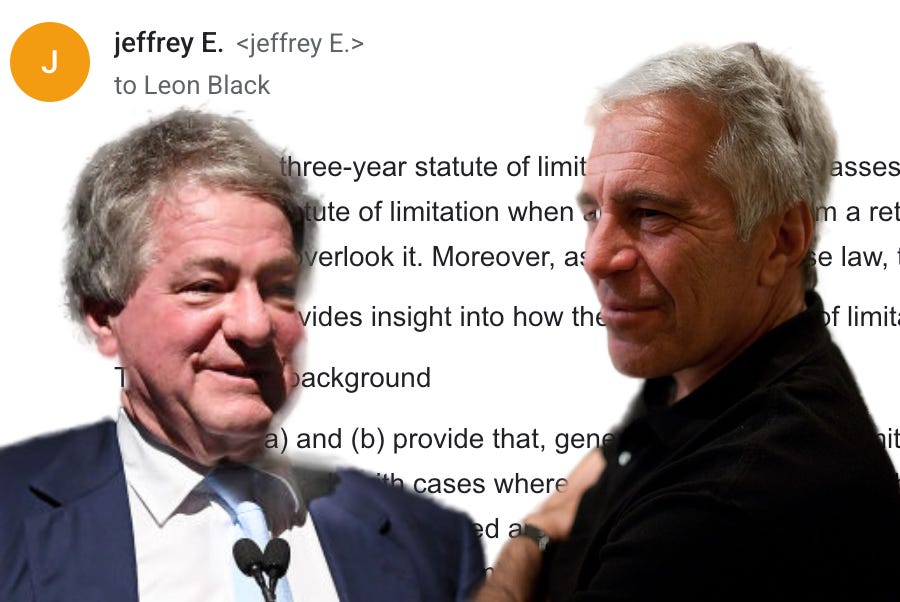
“Deciisions needed asap,” Epstein at one point writes to Black, a billionaire Wall Street private equity titan who was paying a convicted pedophile to manage his money. “1 phaidon. topco etc. . ( cash needs) many wires needed !! 2 new trustee or not. - new decantings 3 art in art partnership.??! .overdue ?! 4 grats? window - 5 art space. .6 regan arts..7 plane simplify re strucuture re finance. re purpose . 8 .boat restrucutre , sister, 9 re fresh estate plan.”
If you have spent time in the Epstein files, you already know what I’m about to say, but if you haven’t, you should know this: to read through the emails is to spend a lot more time with emails like the above than with anything having to do with sex crimes. In retrospect, that is obvious: powerful men don’t usually email about their abuses. But when I began working on the files, I suppose I had been expecting an unprecedented window into a barbaric story of trafficking and exploitation. And I was struck: These — these — were the emails? For every message that felt like even a wisp of smoke possibly tied to some unseen smoking gun involving the sex crimes, there were, I don’t know, 20, 50, 100 of these.
As the media and the public began to dig in, the search settled into a classic needle-in-a-haystack situation, with highly trained professionals and armchair amateurs wading through the muck of art partnerships and decantings to get to the criminal stuff. Sex crimes were needles, world leaders and corporate captains were needles, President Trump was the biggest needle of them all.
But the more I read, the more I found myself thinking about all the haystack emails. The more boring they were, the more I somehow convinced myself that insight was lurking there, too. It began to seem like this was a historic, unfiltered view into how a bunch of very rich people conceive of life and shape the world for the rest of us.
As I have argued before in this series, the most salacious, extreme, and unlawful things that occurred in the Epstein network were nested within a larger culture of behaviors, beliefs, mores, and systems that enabled the worst of the worst conduct. This is a story not just of predation but of power, and of power enabling predation.
This chapter is about the haystack, the truths hiding in plain sight in the most abstruse and boring emails. It’s a glimpse into what I came to think of in reading the files as Rich Brain: an approach to the world that is all about how to protect what one already has — and very little about how to create anything new for anyone else.
Until his Epstein-related fall from grace in 2021, Leon Black was a Wall Street high flyer. Co-founder of the private equity giant Apollo Global Management, which managed more than $1 trillion in assets on behalf of institutions like pension funds and unions, Black was one of many ultra-wealthy people who let Epstein worm his way into their lives, first as a friend, then as a financial consigliere. Epstein began to handle Black’s financial affairs in 2012, helping him set up his estate, organize art purchases, establish his family office, avoid unnecessary taxes, and more. All told, Black, a billionaire, would end up paying Epstein some $170 million in fees.
As The New York Times reported last October, Black’s friendship with Epstein spanned the gamut of the two men’s range of interests: from young women to money to the arts. Black has been tied to various young women introduced to him by Epstein, and has reportedly paid settlements to some who have accused him of sexual misconduct. He denies these claims.
Black was just one of many Epstein helped with wealth management. Strangely, Noam Chomsky was another, when a dispute arose over his family trust. Epstein also reportedly worked in this capacity for Ariane de Rothschild, among others. But it is Epstein’s emails involving Black that provide the most vivid portrait of Rich Brain, of how all-consuming it must be to devote oneself to mummifying money.
The poor think the rich have it easy, and they do. But they also don’t, because wealth on a scale like theirs is not natural, and it takes a lot of contorting to keep it theirs. The price of being rich, it sometimes seems from these emails, is that you have to think all day about being and staying rich.
A notable fact about the Epstein-Black emails is that many, but not all, were sent by Epstein directly to Black, via his assistant. Though Black was a billionaire with lots of people working for him, these were evidently things he had to think about and decide himself. This was what his brain had to be focused on. This was a mental load he accepted, because it was a priority.
Here is one such email from October 2015:
Office, ada goes. , hire heather a paralegal. Joslin goes or is closely managed by new cfo with tax experience. castrucci goes asap as he merely adds to mess. too many people, ex 7 people or more to pay a bill. eva goes. outsource as much as possible. bookkeeping systems built from scratch, airplane restructure, boat same, new grats. phaidon sale, decide on artspaceregan, do the kids really want these? children accounting ie bens house. re do estate for new facts. redo loans, trading accounts activity, gaming -foreign- disclosures. BRH TRA re thinks. household and construction architects. redone. art partnership, choice of paintings. re do structure of consultants. tax re family office. decide if investments are a realistic option in the next three years. insurance. operations. airplane, etc. art foundation, private. max charity contributions. financial reports. still waiting. on line banking, tax planning, family office deductions (profit center). airplane certificate, redone jet aviation redo. paper gigi trust to avoid gift tax.
So here we have Epstein first of all recommending various personnel changes to Black. You need a new guy with tax experience, presumably not out of a desire to pay more in taxes. You need to restructure your airplane, which one takes to mean financially. And your boat. You need to deal with what your children are getting, keeping. You need to deal with estate plans and architects, set up entities to purchase art instead of just, you know, purchasing it. You need to maximize your charitable contributions — again, the drive to maximize may or may not have been related as much to taxes as to a love of humankind. You have to figure out how to duck the gift tax. And on and on and on and on.
Is it me, or are you exhausted right now? Maybe I’m just singularly bad with mail and paperwork and things like that. But if I had Black’s kind of money, I can assure you that the first thing I would buy with it is not having to think about arid shit like this.
But I’m no longer surprised. When I first began to encounter people in these worlds, I was taken aback. I guess I had assumed that having more money would liberate you from thinking about it and stirring it every ten minutes like some tomato sauce.
I will never forget The New Yorker’s devastating portrait of Julian Robertson, another billionaire financier who some years ago became embroiled in a case about whether he had evaded New York City taxes. The city levied a top rate of 3.6 percent, which you could avoid if you spent less than 183 days in the city. Though Robertson was in his late sixties at the time and worth billions of dollars and had an estimated income in the contested year of more than $700 million, he went to staggering lengths to organize his life to avoid needless city days:
This was nearly a full-time job. One of Robertson’s assistants, Julie Depperschmidt, scheduled his appointments and maintained a contemporaneous computerized record of his whereabouts, carefully distinguishing between “NYC days” and “non NYC days.” Different colored boxes indicated confirmed and anticipated non-New York City days. Whenever the combined number fell below a hundred and eighty-three, she advised him to add more non-New York City days to his schedule. She said that she reminded him “ad nauseam” about what he needed to do to reach a hundred and eighty-two non-New York City days.
Friday nights were particularly risky, since Robertson or his wife often had social events scheduled in the city. In order to “earn a tax day,” as he put it, he usually left town on Friday before midnight, even if his wife stayed at the apartment. Robertson’s driver had to be on alert: as long as they crossed the Queens border en route to Locust Valley by midnight, Robertson didn’t have to “waste” a Saturday as a New York day. Even one minute of a day spent in the city counts as a day of residence.
I remember reading that article and having the same thought I have had more recently, reading the Epstein-Black emails: This is what you spent your time thinking about? This is what interested you when you, more than almost anyone, could have spent your time thinking about anything?
Epstein had a knack for poking into insecurities. The rich worried they weren’t smart enough — hook them up with academics. They also worried they were ugly and boring — hook them up with young women. The academics worried about funding — hook them up with rich people. The former government officials worried about staying in the game — hook them up with access and pry information out of them.
In his emails to Black, Epstein displayed another of these astute understandings: a billionaire like Black wasn’t necessarily consumed by what could be built, but by the fear of squandering what had been amassed. Notice the use of the past tense here:
i architected and built you an amazingly elegant house... your house manager has let the water run in many of the rooms, shut the doors. told some of the staff to mind their own business, the basement is flooded and gets worse every day. your school chum is standing knee deep in rising water (tom is affable, brad is trying and your in house counsel is trying to decide jurisdiction and liability if she turn off the taps. your family office is comprised of super cheap furniture, cheaper IT and low priced help. I believe you need an office for your family, your future and IT that is technologically up to date and upgradable. you want to leave your kids the quality equivalent of your art collection. Leon ITS NUTS
Here, again, there is a lot going on. Wealth is not a tool for creation in the world. It is a metaphorical house you own, one Epstein helped build. In this telling, the outside world is less a place to make things happen than a source of threat to the wealth you have accumulated. It is water seeping in. It is time wearing things down. The way to live is to resist this financial entropy.
At one point, Epstein appears to be trying to collect more money from Black, and he lays out the challenges of wealth defense:
You and your family are a 6 billion dollar corp. with an income between 250 -500 million dollars per year. It contains a few operating biz’s , a large wide array of existing investments, in various categories , a desire to enter into others. A panoply of loans, notes. purchases, wide range of all types of taxes. , planes. boats homes.. trusts ,grats. a crazy number of bank accts. ( with no oversight ) . law firms, acct firms, 800 page tax returns, foreign firms. art consultants. construction consultants bill payers, home mgmt.,vast multitude of Ilc’s , including foreign.
This is obviously a lot to think about, and it must be thought about constantly, and here Epstein hoped to make himself valuable: “Your family office needs a daddy,” he wrote, meaning…himself. “children with good intentions are running around , sniping , nitpicking with little direction.” And on the message went, with talk of lines of reporting and employee training and, above all, the desire of Epstein to get paid.
The decision list that Epstein was leaving on Black’s doorstep could be maddening:
…10. tra review , sale. , 11 brh, doc review, 12. sale of stock or art ? tax, rent sale 13 . gifts of art. 14. charity current and future pledges , gifts, 15 cash flow. . 16 . new IT and new personnel. 17. operational re-do ( bill pay etc) . 18 debra and children ? current and future involvement . notifications etc.. new dynasty trust ? 19. tax plan and dislosures gaming. foreign apollo and phaidon related . 20. investments rationalize incl trading accouints . 21. bank loans . rates ? ? terms etc. consolidate. plane boat houses. disclosures? 22 . consolidate and review and reduce the number of all bank accounts and legal entities. decanting liquidating etc. . 23 all outside consultants? valuations etc. 24 review legal bills carefullly. 25. third party responsibilty Bens house , alex films . Etc…
I understand that little of this will make sense to you. It doesn’t make a whole lot to me. But amid the typos and grammatical scree is a crystalline clarity about priorities.
If “wealth creation,” a phrase we often hear in our politics and discussions about taxation and entrepreneurship, is something that happens “out there” in the physical world, here the conversation was more about wealth conservation for the next generation.
In our discussions of whether or not to tax wealth, this kind of wealth, conserved in these kinds of ways, isn’t typically the focus. But it accounts for a huge portion of the wealth we are talking about. And it is worth thinking about whether we want to extend the deference we do to the allegedly societally fruitful work of crafting trusts that own LLCs that own shell companies that hold art that may one day be donated to a museum that will give a tax deduction.
Epstein played on this universal parental anxiety for one’s children — in this case, an anxiety inflected by Black’s immense wealth: “the tasks at hand are the following. You have a bomb of colored string that your retarded children have formed, It has to be very carefully unwound.”
Black is being warned of the thing ultrawealthy people fear most: a return to the mean. Black was unimaginably successful. But his children, in Epstein’s telling, were incompetent at holding the wealth. Left to their own merits, the wealth may vanish. Some might say that is as it should be — nature healing. But no: if the rich man is willing to keep his mind set in Rich Brain mode all the time, he can make moves to spare his children from meritocracy. He can ensure their wealth without the burden on them of having to generate ideas. He can secure their right not to be societally fruitful but societally useless.
A tweet — they were still called that then — I think about often is by Michael Roston, an editor at The New York Times. He seemed in turn to be paraphrasing a quote I can’t find from Choire Sicha. He wrote:
Was it @choire who wrote that while you’re worrying about the future of journalism, the people who control the money are trying to make sure the right car goes to the right house?
I think about that quote often: its suggestion of a mismatch between the responsibilities of our elites and their actual mental investments; its insight that wealth doesn’t necessarily liberate you from life maintenance but can actually so overcomplicate your life that maintaining it becomes the overwhelming project; its observation that, in an age of epic and existential societal challenges, those with the resources to think about them may…not be.
To the extent that the easy ride we give our billionaires, tax-wise, is premised on the pregnant thoughts they are gestating all day, it may be useful information to know how much of their effort is spent on such thoughts and how much is spent trying to establish modalities of the kind Epstein was offering Black and so many others. No matter what they tell you on Instagram, the central anxiety of our oligarchs may not be that extraordinary things won’t be created. It may be that one or more of their descendants will have to return to the cursed ranks of that great mass of human beings who exchange their labor for money.
Something middle-class people may not realize is that an age of yawning inequality actually makes very rich people more anxious, too. Once again, you might imagine a liberating effect of extreme wealth. But that isn’t how it turns out to work. The cost of sinking into the below-ground becomes more unimaginable. The abyss becomes more terrifying. And, therefore, changes to the system, higher taxes, rising populist tides — all of it is terrifying. Wealth taxation, specifically, like the new proposal from Senator Bernie Sanders and Representative Ro Khanna for a 5 percent annual wealth tax on America’s nearly 1,000 billionaires, triggers especially visceral feelings. The billionaire class often takes it like a punch in their grandson’s stomach.
In an environment like this, the mythmaking becomes all the more important. That we collectively extend the billionaire class this deference, hitting many working-class families with a higher effective tax rate, must be even more strenuously justified. This paternalistic idea of the billionaire class — don’t disturb our national daddies, sweetie; they are busy inventing ideas for us — acquires an existential importance.
But in the crack in the edifice of oligarchy that is the Epstein files, what we see tells a different story. I didn’t come across many nation builders in the files; I saw a lot of maintainers. I didn’t see a lot of job creators; I saw rent seekers. I saw a lot of worrying about how to hold, not build. I didn’t see people thinking along the lines of the abundance movement; I saw a lot of high-end scarcity thinking, the anxiety of bank account conservation. I didn’t see a lot of dreaming about the transformation of the landscape of the country and the lived texture of daily life; I saw a lot of stuff about LLCs for the purchase of paintings. I didn’t see a lot about what tomorrow could be made like for all; I saw a lot about ring-fencing yesterday’s spoils for a few.
To the extent that we have chosen — and keep choosing — to maintain this oligarchic class at our expense, through the tax rates we set, the regulations we impose, the programs we create, and do so out of a belief, conscious or not, that, even if they are gaudy, our overlords are of societal value, that there is a method in the madness of some people not eating so they can have a tax break for their jets, maybe let’s not?
At The Ink, we work for you. When you join us, you stand up for independent media that isn’t afraid to tell the truth. Subscribe today and help us keep the lights on, pay our writers and editors a fair wage, reach more people, and build the kind of media that you want to read.
A key benefit, or luxury, of having wealth is to live where you want to live. It's nuts to play the tax domicile game as Julian Robertson did.
Great piece Anand. Now I understand why we cannot depend - necessarily— on the rich to help fund candidates that offer new ideas to change our systems. For me, at the bottom of all of it is an unconscious misogyny that transcends gender that is also working feverishly to keep white men in control….of money. Thanks for this work.