


This is the fifth and final part of my in-depth portrait of the rise of Alexandria Ocasio-Cortez. (Find the first installment, and the series introduction, here. Find the second installment here. Find the third installment here. Find the fourth installment here.) Today’s chapter tells the story of how Ocasio-Cortez navigated among gatekeepers on the left and critics on the right while trying to play the ultimate inside game in American politics: pushing a historically moderate president to change. It lands in a question that continues to hover over Ocasio-Cortez: Does success for her and her movement look like stretching what is possible, moving the Overton window? Or does it mean leading?
Special thanks to my publisher, Alfred Knopf, for permission to unlock this for Ink readers. This report first appeared in my book The Persuaders.
The rise of AOC: Part 3: Power
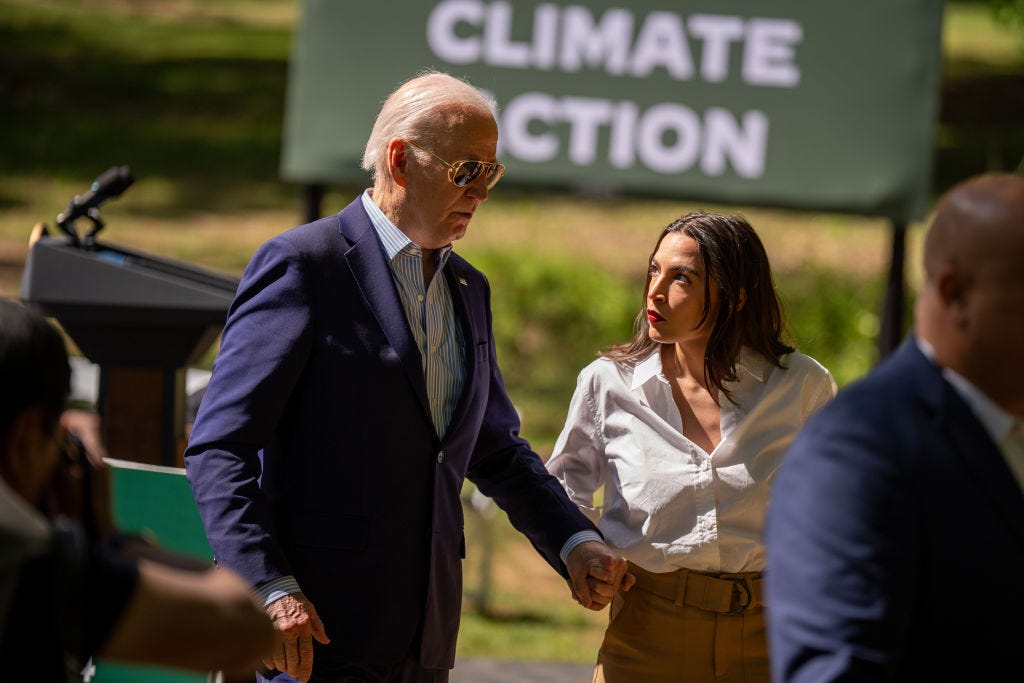
Thus in the late spring and summer of 2020, Ocasio-Cortez pursued the kind of multitrack politicking that might have been hard for people less prone to world-straddling to understand. In interviews, she was cool to Biden, jettisoning the usual Washington custom of coming around to enthusiastic support of the nominee, whoever the nominee is. But when Sanders and Biden formed unity task forces to synthesize positions amenable both to the moderate faction that had won the election and to the progressive faction that had much of the party’s grassroots energy, Ocasio-Cortez was invited to join one—as the co-chair, alongside the former secretary of state John Kerry, of the climate task force. She was criticized by some on her left flank for capitulating to Team Biden. But she joined anyway, and a spokeswoman, Lauren Hitt, told reporters that Ocasio-Cortez would be “fully accountable” to climate activists and “believes the movement will only be successful if we continue to apply pressure both inside and outside the system.” One of her fellow task force members was Varshini Prakash, whom she had joined that day in the occupation of Pelosi’s office. Facing the same risks of friendly fire as Ocasio-Cortez, Prakash said publicly, “As I step onto this task force, I’m taking each and every member of our movement with me. I will fight as hard as I can for a platform that will do the most good for the most people.” And, by all accounts, this time, on this score, their gamble proved correct. Biden’s climate plan moved significantly. Noam Chomsky, a hero to many leftists, pronounced Biden’s new-and-improved climate plan to me as being “farther to the left than any Democratic candidate in memory” and “far better than anything that preceded it,” and “not because Biden had a personal conversion or the DNC had some great insight, but because they’re being hammered on by activists coming out of the Sanders movement and others.” Chomsky described Biden’s new plan as “largely written by the Sunrise Movement.”
In one of our conversations, I asked Ocasio-Cortez about the criticisms she received from the inside types about her activism and from the outside types about her capitulating to the game.
“No matter where you are on the political spectrum, the moral of coalition building is this idea that we need each other, especially when it comes to organizing around social change,” she told me. “Some people are of the belief that electoralism is the only vehicle that we have to enact change at any sort of broad level. Other people are of the belief that electoralism is broken beyond repair and it is a dead end when you look at the profound influence of dark money and X, Y, Z ways that American democracy is fragile, imperiled, or broken. The thing I keep coming back to is that it really isn’t one or the other. It’s that we need each other.
“There are certain things that can be accomplished electorally that simply cannot be done with grassroots organizing,” she continued. “There are some things that can be done with collective mass movement that will never be accomplished through electoral means. And, in fact, going beyond that binary, both of these types of work and organizing are necessary for the success of the other. Yet you still have hard-liners in both categories.”
She was bothered by the monomania that could creep into the discussion of these approaches. She respected the activists who pushed from outside, who reminded her of her; she respected those who, like her, had chosen to go inside. But the loudest voices in politics belonged to those who believed that the only valid approach to change was the one they just so happened to be invested in. She likened her work in politics to her father’s work remodeling homes. It took many tools, and there was a time and place for each tool, and different people might use different tools. But in politics some of the metaphorical carpenters “think that if you’re painting the house, you’re a bad person or being counterproductive.”
“Their job is to give us the blueprint,” she said of the activists. “And my job is to try to build the damn thing. Sometimes you do the inspection and a beam doesn’t have structural integrity. Our job is to actually get the sand and dust in our face, trying to bring all of these crafts together. It’s not easy, because while a lot of folks do understand the collaborative and distinct efforts that are necessary, there are some folks who think building a house is just a matter of hammering the wood together and that you don’t need anything else.
“Whether we like it or not, these decision-making bodies are full of human beings,” Ocasio-Cortez went on, “and not everyone who makes decisions makes them the way that we make them. Sometimes there are some folks who make their decisions based on political conditions. Sometimes they make it out of ego. Some people really do pick a side based on who’s nicer to them. We don’t like to operate as if that is the reality because we don’t think it should be the reality. But just because we don’t agree with it doesn’t make it less true. There are some people who just need to feel welcome, who need to have the carpet rolled out for them. And some people on the outside may be resentful of that. The way that I feel is, ‘Listen, if rolling out a carpet for someone brings them to our side, then I’m okay with that.’ I don’t expect everyone else to be okay with that. My role is to do some of those things that activists and other folks wouldn’t and, frankly, shouldn’t.”
But Ocasio-Cortez did fear for a progressive movement in which those on the outside and those on the inside didn’t have enough faith in each other to let each other take those different tacks toward the greater goal. “Any healthy relationship comes down to trust, and where there isn’t trust, you have a very fragile, brittle relationship. And if you have a very fragile, brittle relationship with the people who are most on your side, that proves the point as to why our movement needs to grow and trust, instead of try to gate keep and distrust.”
She was making a case for what the scholar Michael Dawson has called “pragmatic utopianism.” But she wondered aloud as we spoke whether she, as a woman of color, and one who had landed in the limelight in the way she had, would ever command the goodwill to pursue that dualistic, this-and-that approach. “There is an enormous subtext of racism, classism, and misogyny, and it can be a frustration of mine that white male colleagues, or even just white colleagues or male colleagues, who have the same position and stances that I do, who came in with the same coalition and grassroots people power that I did, are not held to the same standard,” she told me. “I don’t have the built-in generosity and I don’t have the built-in trust that someone like Bernie does,” she said. She acknowledged that he, of course, had built that trust over decades. Still, sometimes, like her, Sanders played the inside game and put faith in the process, and he was seldom called a sellout the way she was. Contrarily, Ocasio-Cortez said, “I’m seen as much more divisive than someone like Bernie, even though we have virtually the same platform.” The isthmus was especially slender for her.
When it came to the Biden candidacy and, later, presidency, Ocasio-Cortez would continue to juggle the inside and outside ways. The way she voiced the role she wanted to play with Biden was this: “It will be a privilege to lobby him.” She told me that with Biden in office “it’s really important that we push, because I don’t think we can just trust that things are going to move in a progressive direction because the clock is ticking. We have to fight for it. And fighting for things often means that you get labeled as radical and a firebrand and difficult and inconvenient and not a team player. Because team players buckle up and saddle in and they stay quiet and they don’t make people uncomfortable. You know, there’s something to be said for that, but that’s never been who I am.”
But that spring and summer, she really was both: the team player on the climate task force, taking advantage of the privilege to lobby Biden, and then a speaker at the Democratic National Convention late in the summer, where her approach spoke of her difficult balancing act. On the one hand, she was lending her voice to the broader party she often criticized. On the other, her choice of words reflected an overriding desire to stay true to her base and her most ardent admirers, and less of an interest in using the moment to win over millions of more moderate and even conservative Americans, many of whom would be hearing her at length for the first time.
Her formal assignment had been to place Sanders’s name in nomination, a ritual recognizing the runner-up in the primary contest. In doing that, she began,
In fidelity and gratitude to a mass people’s movement working to establish twenty- first- century social, economic, and human rights, including guaranteed health care, higher education, living wages, and labor rights for all people in the United States; a movement striving to recognize and repair the wounds of racial injustice, colonization, misogyny, and homophobia, and to propose and build reimagined systems of immigration and foreign policy that turn away from the violence and xenophobia of our past; a movement that realizes the unsustainable brutality of an economy that rewards explosive inequalities of wealth for the few at the expense of long-term stability for the many, and who organized an historic, grassroots campaign to reclaim our democracy. In a time when millions of people in the United States are looking for deep systemic solutions to our crises of mass evictions, unemployment, and lack of health care, and espíritu del pueblo and out of a love for all people, I hereby second the nomination of Senator Bernard Sanders of Vermont for president of the United States of America.
I was struck by the intelligence and moral commitment of the speech and by the political choice it seemed to represent. Here Ocasio-Cortez seemed to decide to do the opposite of what she had done with the tweet about McCain’s death. Here she was not trying to expand, asking her hard-core supporters to trust that outreach was not capitulation. Here, instead, she was using one of the biggest platforms she would ever have to bring the language of outside activists inside. She was sticking to clear and demanding language that often gets leeched from politics as the price of broadening the tent. She could have told her moving story about being a waitress, sick and tired, and regaining a sense of humanity when she learned about Sanders’s campaign, or any of a number of other stories. She could have given the West Wing version of the speech, generalizing, sentimentalizing, and softening the language of political struggle: instead of homophobia, saying love whomever you love; instead of colonization, saying people everywhere should decide their own destinies; instead of racial injustice, saying every American deserves a chance to realize their potential. To move in the direction of these other phrases would have been to move away from a galvanizing framing and toward a more broadly appealing rhetoric. But on this occasion, Ocasio-Cortez resolutely stuck to an undiluted, fierce critique of the system. Up to this point, she had, in a way Sanders had resisted, used herself to draw attention to those greater forces. But now, in the spotlight she had won, she did the reverse. She went full structural, worrying less about being appealing to everyone than about being unclear. These were her movement’s demands.
It seemed she worried about not only an excess of purity but also an excess of outreach. Reach out too far across the chasm, and you fall in.
The following January was a strange time. Ocasio-Cortez was sworn in for her second term, having cruised to victory in the November elections that tossed Trump out of office. There was an insurrection on the Capitol that attempted to overturn that election and traumatized Ocasio-Cortez to her core, and prompted her to speak publicly and movingly about trauma and being a past victim of sexual assault. There was, later in the month and in spite of that attempt, a new president in office who in many ways epitomized the kind of moderation she had set out to thwart. Yet there were signs when Biden took office that he wasn’t entirely the man he had been before, and the persuasive labors of Ocasio-Cortez and her progressive allies were among the many reasons why. In his address to Congress in April 2021, Biden went after the core gospel of the Reagan revolution forty years earlier—that government is the problem, not the solution. “It’s time to remember that ‘We the People’ are the government. You and I,” Biden said. “Not some force in a distant capital. Not some powerful force that we have no control over. It’s us.”
It was an unlikely turn for a Democrat who historically had run on personal decency more than he had pushed for structural decency. Back at the dawn of the neoliberal era, in 1981, when Reagan got to work slashing both government and taxes, he had a perhaps ambivalent ally in the young senator from Delaware. Biden voted for the package of tax cuts and austerity measures that is now viewed as the seedbed of the Reagan age. But now President Biden seemed as if he were embracing the idea of ending Reagan’s long postpresidential reign, more than Clinton or Obama had, and backing it up with staffing choices and spending proposals.
When I asked one of his longtime advisers, Mike Donilon, about Biden’s change of heart, he said, “This really is the place where we can change the paradigm of how government has operated since Reagan.” Then, being the loyal stafer he was, he sought to frame the change in his boss as a continuation: “One thing he has always believed is government can be a force for good in people’s lives.”
But it wasn’t really continuity. Biden had changed, was saying new things, pushing for bolder policy, proposing three separate spending bills, each costing more than $1 trillion, in his first year, touting the idea of a historic repair of a broken safety net. Why? I asked Donilon.
“The pandemic has fundamentally changed a lot about the country,” Donilon told me in that spring of 2021. “I don’t think you can go through an experience where 500,000-plus people lose their lives and everybody has their life turned upside down and you reach unemployment levels approaching Depression-era levels and come out of that the same.” Because the pandemic exacerbated so many other, longer-running trends, Donilon said, the president “believes the country is in a place where it wants to do big things and wants to do transformative things.” It was interesting to hear how Donilon put this: it was the country, not Biden himself, that was the protagonist of the story.
Some of these things Biden would go on to achieve; many he wouldn’t. On some issues he would fight; on others, such as a minimum-wage increase and his plans to upgrade the safety net and fight climate change, he would give in too easily, in his critics’ eyes. But during the campaign and then in those first months of his presidency, what stood out to many political observers was this president, of all presidents, driving a turn away from a center-right consensus of which he had been a card-carrying member.
Many factors had made the new consensus possible. Among them was Representative Alexandria Ocasio-Cortez. And now she had the peculiar experience of watching a legacy she and Sanders and others had helped shape bloom in the hands of improbable others. Her Plan A had been to help Sanders win and, if he had, to be at his side in one way or another. This was Plan B: a moderate president taking aim at the ideas that had guided his own career, because she, alongside others, had helped to discredit them. This, too, was persuasive success, if of a quieter kind. (But also of a less reliable kind: in the end, Biden would fail to get his sweeping Build Back Better bill through in his first year, and talk of progressive influence on him faded.)
It was a complicated line to walk for Ocasio-Cortez. One wanted to be able to recognize the kind of win that can come in losing. But there was also the fear that if you did count your influence on Biden before it hatched, you would end up being a political cheap date, offering him credit for little and letting up the pressure, giving him space to regress. So it was a confounding moment for Ocasio-Cortez, at once frustrating and validating. Yet around that very time when she, along with others in the progressive movement, deserved credit for, at a minimum, changing the course of the conversation, she, of all people, was under fire for allegedly being a sellout to power.
The attack on her as a sellout was propagated by a wing of progressives who wanted her and others to make greater use of leverage in pursuit of her goals. A loud voice in this faction was a progressive comedian, a provocateur named Jimmy Dore, who, through his YouTube show, went after Ocasio-Cortez as a craven insider who had abandoned her outsider integrity. Dore had specifically wanted Ocasio-Cortez and other progressive members to withhold a vote to re-elect Pelosi as Speaker until Pelosi brought Medicare for All to a vote. This came to be known as the plea “Force the Vote.”
“She is standing between you and health care,” he told his fans.
Ocasio-Cortez, like many of her colleagues, declined this outside advice from Dore and from his legions of online fans, who piled on to the idea. The advice also ran contrary to what many other progressive groups thought the shrewdest strategy to be. But the nuance of the position taken by Ocasio-Cortez and these groups—balancing the provocation and primary threatening of establishmentarians like Pelosi with meeting them where they are and seeking to win by growing the coalition—was easy to cast as weakness by a figure like Dore. In calling out Ocasio-Cortez, he built his subscriber base, and he tried to do what damage he could to the political brand of one of the most progressive legislators ever to serve in the U.S. Congress.
“You liar. You coward. You gaslighter,” Dore barked at Ocasio-Cortez.
Writing in New York magazine, Eric Levitz offered a different view:
Ignoring the structural obstacles to single-payer’s passage, the fragility of public support for the policy, and the simple fact that people can share political values while earnestly disagreeing about the best way to advance them— all for the sake of declaring Alexandria Ocasio-Cortez an enemy of America’s uninsured—is a sound strategy for ginning up interest in your rant-based YouTube show. But it is also a recipe for converting your politically naïve viewers into anti-political cynics and making the U.S. left as self-deluded and internally divided as corporate America wishes for it to be.
I asked Ocasio-Cortez about the toll of these attacks. “One of the things that I confide when I talk to other people in movement spaces is that we’re not used to winning,” she said. “We’re used to losing for almost all of American history. Or when we get some sort of toehold, we’re used to being crushed. So when we do actually have power, we don’t know what to do with power. Because we have spent almost our entire lives critiquing power.” She added, “If your whole identity is based on how marginal you are, and if your whole affirmation and sense of self-worth is based on how much you get or see something that other people don’t get or see, you will always be losing. Some people, I think, have associated a moral purity with losing. It’s as if, if they’re winning, there’s something wrong, or that you have compromised your morality in some way.” She likened the behavior of such activists to that of the music fan who burns a record she has long loved once she discovers that others listen to it, too.
And yet she understood where they were coming from, because very often her colleagues in the Democratic establishment would disappoint her, too, and she wouldn’t hesitate to call them out. Late in the fall of 2021, after Democrats suffered a stinging election loss in the governor’s race in Virginia, and amid seemingly endless (and ultimately doomed) negotiations to secure Biden’s social policy and climate bill, known as Build Back Better, Ocasio-Cortez delivered a stern warning to party leaders in the pages of The New York Times. “We always try to tell people why they need to settle for less, instead of being able to harness the energy of our grass roots and take political risks in service of them, the same way that we take political risks in service of swing voters,” she said. She spoke of the Congressional Progressive Caucus’s insistence, throughout the negotiations, only to vote for Biden’s bipartisan physical infrastructure bill if the more progressive social policy legislation was assured. “We’re like, listen, we’re not going to take these empty promises anymore,” she said. In the end, much of that caucus capitulated and voted for infrastructure with a promise, not a guarantee, of the social policy bill. Ocasio-Cortez voted no on infrastructure, however, and immediately she was attacked for seeking to deprive her constituents of help. But she was vindicated when the supposed “deal” to pass both pieces of legislation crumbled. Build Back Better was shelved as soon as the progressives’ votes on infrastructure were secured.
Her early tenure revealed the complications and perils of the inside-outside game. She had altered the terms of discussion as much as any new member of Congress in American history, but for a slice of her own ideological base she would never do enough. She was also never going to be trusted by the establishment. The desire for expansion could cost her the trust of her diehards, and perhaps that desire could even risk actual capitulation. Keeping her foot in the movement kept her at a certain distance from the center of power and from the skeptics whose support she needed if she were to achieve major change. What couldn’t be taken away was her legions of supporters, who came to her for solace and faith and hope.
The question that hovered over Ocasio-Cortez during that year of her arrival and beyond it was whether, in this moment in the cultural life of a country boiling over, she would be given the space and freedom to go this way—to be all the things.
On a summer afternoon many months later, as we sat on benches in the grass, I asked Ocasio-Cortez what it felt like to watch certain of her ideas and themes take hold in the country even as her own movement struggled to win the victories to show for it. That question took her mind back to the beginning of her foray into politics and to the question of her political future.
It took her back because when she was deciding whether to run, she remembers asking herself, what would make this time, effort, energy, sacrifice worth it to me? she said. “Because there’s a way where you win and it’s not worth it, and there’s a way where you lose and it is worth it—or you lose and it wasn’t worth it at all.”
The answer she had given herself back then was that if her community was “more invested, educated, and organized at the end of this process than it was at the beginning, then it will have been worth it,” she said. She felt good about that when the primary victory came. When she won the general election and headed to Washington, she asked herself the question again, now on a bigger stage. “Something that was really important to me was telling the truth and bringing transparency and making people feel like they actually have power and a say in their government,” she said. Because she set herself that goal, she went on, “I was willing to do things that would probably put a very hard ceiling in terms of what would be politically possible for me positionally in the future. It’s not that I set out to be edgy and be whatever, but I wasn’t going to allow any sort of dangling of positional opportunity to prevent me from telling the truth and engaging people, even if it was uncomfortable within our own party.”
She seemed at times to tell herself that she didn’t have a political future in order to wring from herself the most honest version of herself. And now, even as her own fans spoke of a President Ocasio-Cortez, or at least a Senator Ocasio-Cortez, maybe a Governor Ocasio-Cortez, she was asking herself questions more commonly heard among those much older than her. “How do you know when you’re done?” she mused as we spoke that day. “How do you know when you’ve accomplished what you can accomplish? I don’t know. I ask myself that pretty often, and it’s a tightrope between what’s possible now and what could be possible for our country in the future.
“I really struggle with feeling some days like there is no path forward for me in terms of a material possibility, but I’m okay with that because I’ve decided what’s important to me,” she said.
I had heard her say this before, and it always caught me off guard. Here was one of the more promising talents in modern American politics, and she often sounded as fatalistic about her own prospects as anyone in the arena. I said I perceived her as being more attracted to being done with politics than to rising higher within it.
“There are some days when I do feel that way,” she said. “For me, from day one, practicing nonattachment to this has been very important, because that’s what allows me to do what I do. If I was attached to my seat, if I was attached to future political possibility, I would not be able to say the things that I say, and I would not be able to hold our own party accountable.
“The thing that has given me the greatest sense of power is not letting people have power over me,” she said. “The way that they try to exercise power over me is, ‘You’re never going to get anywhere in this party. You’re never going to be able to run for anything again.’ When you actively don’t care about that, it’s the political equivalent of having fuck-you money. You can’t fire me. You can’t bankrupt me. I don’t value the things you think I value. That precisely is the source of power. The thing that they fear the most is what they don’t control.”

Brilliant. Now need an Anand update on AOC 2026 — post October 7, post Nov ‘24
Would love to hear his take on her continued evolution
Superb insightful portrait of someone who is honest and admirable….so needed in these times.