


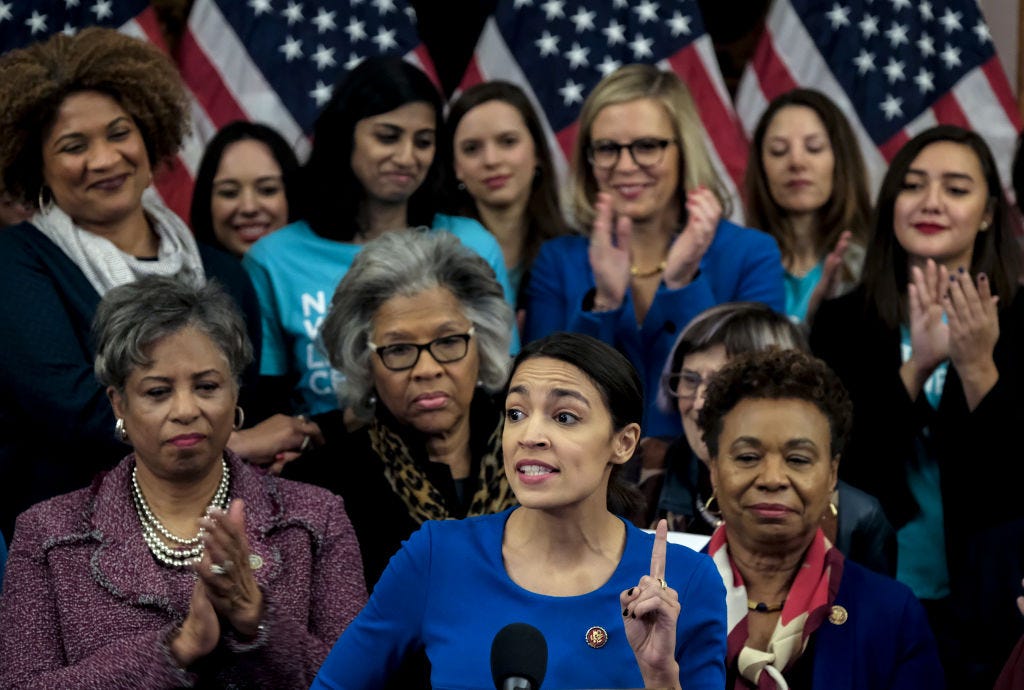
This is part three of my in-depth portrait of the rise of Alexandria Ocasio-Cortez. (Find the first installment, and the series introduction, here. Find the second installment here.) Today’s chapter is about how Ocasio-Cortez was swept, as abruptly as anyone ever to live, into fame. And how she learned to think of it as a tool for “seizing and holding attention, diverting that attention up to the larger causes she favored, using the eyeballs to teach.” This is part of what she calls her inside-outside game, and it helped redefine politics in the age of social media.
Special thanks to my publisher, Alfred Knopf, for permission to unlock this for Ink readers. This report first appeared in my book The Persuaders.
The rise of AOC: Part 3: Attention!
While campaigning for the primary, Ocasio-Cortez had struck that delicate balance between being human and relatable and accessible, meeting people where they are, and, at the same time, tossing the occasional bottle rocket into the national political conversation. Now, as she headed toward her seat in Congress, she faced the next incarnation of this balance: being a righteous and radical thorn in the side of her new colleagues and someone capable of doing things with them.
How hard this balancing act would be became evident in the first days of her newfound celebrity as a Democratic dragon slayer. When the House Speaker, Nancy Pelosi, was asked about her soon-to-be colleague, she minimized Ocasio-Cortez’s win as a quirky local story: “It should not be viewed as something that stands for everything else.” Ocasio-Cortez was unafraid to return the favor, refusing to endorse Pelosi’s reelection as Speaker.
“Should other House leaders go, in your opinion—particularly the Democratic leader, Nancy Pelosi?” she was asked by a radio interviewer.
“I think it all depends on a case-by-case basis. I think that the party itself—I look forward to us having new leadership just in general.”
“Well,” the host persisted, “let’s do the case of Nancy Pelosi specifically, then.”
“Well, I think that it depends on our options, you know?” Ocasio-Cortez said. “I’m open to looking at who are other candidates for leadership.” In another postprimary interview, she said that “the issues we even have today may have to do with some of the calcified structures and relationships.”
This was not the customary so-honored-to-be-here curtsying that the encrusted congressional leadership expected. And as several establishment Democrats, including powerful women like Senator Claire McCaskill, tried to cut her down to size on television, Ocasio-Cortez was not shy about hinting that she, and insurgents like her, were coming for them. “Primaries are healthy for our democracy,” she said in a television interview. “I think there’s plenty of incumbents who are doing an amazing, amazing job. But just because you’re in a seat doesn’t mean that you’re entitled to keep it.” And she meant it. The very night of her victory party, she was touting the names of other progressive challengers in other states, including Cori Bush, running for the House in Missouri. With her own primary victory secured, she reportedly seconded volunteers from her campaign to the campaigns of Cynthia Nixon, Julia Salazar, and Zephyr Teachout, who were running state-level primary campaigns in New York against more moderate figures, with the election that September.
Congress is a strange workplace, where you need your colleagues to get things done but you work for and report to not them but the hundreds of thousands of people you represent back home—and/or, in many cases, the lobbyists and donors you may choose to put before everyone else. Even so, it was a fraught way to show up, warning your new co-workers and teammates that you are coming to take them down. Still, shortly after her victory, Ocasio-Cortez and Pelosi had a courteous phone call. “She said that she loved working with Joe, but that she’s actually always wanted younger women in Congress,” Ocasio-Cortez told a reporter later. “Men tend to run at younger ages and women tend to run at older ages. She’s actually very happy to see, you know, some new blood.”
In the months after her primary, Ocasio-Cortez took to the road and took to the airwaves and almost instantaneously transformed into a figure of international renown. She made campaign stops in Kansas, Missouri, Hawaii, Michigan, and California on behalf of local progressive candidates—a road show The New York Times described as “a critical test for whether she and her Bronx-born brand of Democratic socialism resonate in the heartland—and whether she is overplaying her hand.” She gave interviews. Her movements and utterances began to make headlines around the world. She had still merely won a primary in an election for a House seat. Nevertheless, she very quickly had become an icon and a target.
The journalist Raina Lipsitz captured the swirl of Ocasio-Cortez’s new life vividly:
On June 26, few people outside New York’s 14th Congressional District knew who Alexandria Ocasio-Cortez was.
But by the next day, when news spread that she’d toppled her opponent, 10-term Representative Joseph Crowley, in the Democratic congressional primary, she was a national celebrity. She appeared on CNN, Meet the Press, PBS’s Firing Line, The Late Show With Stephen Colbert, The Daily Show, and MSNBC as the fresh face of a revived American left. Her lip color of choice—Stila Stay All Day Liquid Lipstick in Beso—sold out in several stores.
When she appeared a few weeks later at a rally near Wall Street’s Charging Bull statue in Lower Manhattan to endorse Zephyr Teachout, who was seeking the Democratic nomination to become New York’s next attorney general, a large crowd cheered— many of them clearly there to catch a glimpse of Ocasio-Cortez, not the candidate she was supporting.
Photographers—paparazzi?—shouted out, “Alex! Alexandria! Over here!” An “I Love NYC” tour bus pulled up alongside the statue. “Hey, I know her! That’s her!” yelled a guy in a baseball cap, standing and pointing from the bus’s top deck. Dozens of tourists began frantically snapping photos of the young woman whose face, if not name, they recognized—or assumed they did.
Her communicative talents were now being compared to those of legends of American speech-making. Her Twitter account, which had mushroomed toward one million followers, had come to be seen as a political nuke—something you wanted working on your side, something you never wanted launched against you. Her endorsements became an incredibly coveted prize in politics because of their sheer power to send money, volunteers, and social media followers in your direction. She would begin to use her social channels to let you hang out with her while she was cooking, or sometimes she would go live to explain a particular point of policy, or she would manage to do both things at the same time.
“It was just a completely alien change. I was extremely stressed out because it felt like everything I said had so much more weight overnight,” she later told The Intercept. “Even though I didn’t feel like a different person, I felt this immense responsibility of all of these people’s hopes and dreams for our future. It is something that I grapple with a lot because I know it’s not me. It’s like this avatar of me.”
What felt especially strange was watching— almost as if standing outside herself, looking in— as the world grabbed hold of a part of her and sought to turn it into the whole her. She had the ideologue in her, she had the meet-them-where-they-are organizer in her, but there was room for only one story. “It felt like my brain was literally splitting apart,” she told me. Right after she won her primary, she was driving from Kansas, where she had done a rally with Sanders, to Missouri, where she would do one with Cori Bush. As the car sped from Kansas City to St. Louis, she remembers taking in the media coverage that was coming at her from all sides and realizing the strange process under way: a complicated, many-sided person was being turned into a made-for-TV ideological warrior. “What was starting out as a Fox News headline and a Fox News caricature was being adopted as a mainstream narrative,” she told me. “I saw the trajectory and how all of this was being built up. And it’s an ego death, in a way, which is what I was experiencing in that car ride. I had to let go of trying to control this, of trying to say ‘No, you have it wrong.’ That car ride was the time I was like, ‘There’s AOC, and then there’s me.’”
What she labeled the “AOC” caricature, the not-her, was, she hastened to add, not not her. There was enough truth in this portrayal of her to give it purchase and power. She imagined a Venn diagram “where there’s a whole bunch of stuff that’s said that’s completely not who you are; then there’s who you are, but there is that overlap of what is projected and what is true. Am I staunch in my convictions? Yes. Do I believe that late-stage capitalism has largely failed millions of people?
Also yes. Do I believe health care is a right? Yes. Do I believe that huge parts of our governmental and electoral systems have been corrupted? Yeah. And I did protest in the Speaker of the House’s office. I did do that. I am the person who did that. So it’s not that it’s completely false.”
Still, the pigeonholing bothered her. She tried to cope by thinking of it as a tool: “It was like, okay, this just is what it is. And so how do I try to look at this objectively and use it?” In the coming years, she would often lean in to this image of the strident partisan, the bomb thrower, and in other moments she would defy it. But she seemed to make an early peace with the idea that the public would never know the real her. “I don’t think anyone who has written about me has ever accurately captured who I am as a person,” she told me, encouragingly.
Framed in the media as the warrior princess, Ocasio-Cortez became subject, brutally and instantaneously, to the kind of criticism that stalks so many women of great ambition. A reporter photographed her wearing a black jacket and posted it to social media, along with a suggestion that it was “too nice for a girl who struggles.” She began to be framed as an extremist by the right-wing media echo chamber. She wasn’t, in their telling, just wrongheaded. She was dangerous. (The Trump strategist Steve Bannon later told me Ocasio-Cortez was the only Democrat he truly feared, because he thought that she, unlike others, understood how to shift the terms of the conversation and rally the society toward transformational policies.) Meghan McCain, on The View, derided Ocasio-Cortez’s ideas as “petrifying” and worried about their being “normalized,” as though free health care and free college were akin to fascism. The conservative National Review ran a hit piece on Ocasio-Cortez under the headline “The Unserious Face of an Unserious Movement,” drawing the bizarre parallel that her “approach tracks closely with the peculiar insistence of the modern Republican primary voter that if an outlandish candidate is widely reviled, that must mean he’s onto something good.” When Ocasio-Cortez confessed publicly that she was stressed about having to rent an apartment in Washington before her congressional paychecks started rolling in while having to continue paying rent back home in New York, she was chastised for being financially irresponsible, when in fact she simply happened not to be affluent like most people in Congress. She did a photo shoot for Interview magazine, wore designer clothes they lent to her for it, as is the custom in media shoots, and then spent days battling stories that she, a democratic socialist, couldn’t be serious about her ideas if that was a Gabriela Hearst blazer. She became subject to the tedious but unavoidable entreaties of the Debate-Me Guys, such as when the right-wing commentator Ben Shapiro offered $10,000 to her campaign or a charity if she agreed to duel on his show. At first, she ignored him. Then, facing questions about why she wouldn’t debate a Debate-Me Guy, she tweeted, “Just like catcalling, I don’t owe a response to unsolicited requests from men with bad intentions. And also like catcalling, for some reason they feel entitled to one.”
Even as she was succeeding with her approach of seizing and holding attention, diverting that attention up to the larger causes she favored, using the eyeballs to teach, her critics were trying to blunt the edge of these skills by dismissing her command of notice as inherently unserious. They were trying to cast her as a provocateur.
Later that summer and into the fall, when several of the insurgent candidates Ocasio-Cortez had backed came up short—having in many cases been long shots—many in the press and in politics treated it as proof that she had been overhyped and overestimated. “Down Goes Socialism,” read the headline in Politico. “The Ocasio-Cortez wing of the Democratic Party thinks its policies are the path to victory in red states. Tuesday night’s results suggest otherwise.” In New York, Governor Andrew Cuomo, a fellow Democrat of the kind Ocasio-Cortez had put on notice, including by embracing a primary challenger to him in Cynthia Nixon, tried to get even, dismissing any supposed Ocasio-Cortez “wave.” It was, he said, “not even a ripple.” Later in the year, Senator McCaskill would call Ocasio-Cortez a “shiny new object” and declaim that “rhetoric is cheap.” (Unlike Ocasio-Cortez, McCaskill didn’t win her race that year and left the Senate to become a television commentator offering advice on how other politicians could win their races.)
That fall, for a profile in Vogue, Ocasio-Cortez sat down with a reporter and some of her aides and spoke of the personal toll of being at the center of a hurricane:
“It’s just not a normal human experience I’m going through. There’s so many cameras on me out of nowhere. Like, I’m not media- trained—”
“We can’t say that anymore,” says [her adviser Corbin] Trent, who’s media- training her. “It’s not helpful.”
“OK, sorry, sorry,” Ocasio-Cortez says. “I’m just overwhelmed. I’m a normal person, and people treat me now
like I’m this two- dimensional caricature that they project narratives onto. It can be emotionally taxing. Like, what do
you do with young brown women who are intelligent and whose faces are symmetrical? You paint them as a narrative.”
Provocation wasn’t who she was. It was something she used. It was a tool she owned that was being turned by some into her biography. To play with narrative as effectively as she did put you at risk of being manufactured into a narrative, too.
It was a Financial Times headline that would perhaps best capture the blaze of the new congresswoman’s arrival: “Idealist. Infuriator. Influencer: The Year of Alexandria Ocasio-Cortez.”
What may now be called the AOC style—the provocation, the meet-you-where-you-are second sentence, the recognizing and crafting of moments and meaning making around them, the long-game teaching, the offering of the self in service of forcing a conversation about systems— this methodology wasn’t a given; it needed to be invented and developed. And in November 2018, shortly after the formality of beating her Republican opponent, Ocasio-Cortez went a ways toward defining that style on a visit to her new workplace.
It was freshman orientation for new members of Congress, a time to meet your heroes, see your new environs, learn some of the tricks of the trade. But for Ocasio-Cortez, the isthmus of the inside-outside game was inescapable. One moment, she was taking a selfie with a group of three other progressive women of her unapologetic ilk—Ilhan Omar, Ayanna Pressley, and Rashida Tlaib— and, via Instagram, they turned themselves into “the Squad.” More of the we’re-coming-for-you vibe. The next moment, she was worrying about whether the congressional leadership would give her decent committee assignments or would try to shaft her. “Mind you, this is in the middle of lobbying for your committees,” Ocasio-Cortez told me. “This is the work that you are going to do. It’s where you’re going to spend the most amount of your time as a legislator, is in committee, if you’re doing your job and actually going to hearings. This was a time when leadership was determining committee seats. The entire time, even the moment I was elected, people were calling, saying, ‘What committee do you want to be on? What committee do you want to be on?’ And so you could very well get put on what I call the dog-catching committee. You could make all these requests, have all your requests denied, get put in a very small committee that doesn’t really matter much or that is not of interest to you or is not powerful.”
Speaker Pelosi had great leverage over Ocasio-Cortez right then. So when Ocasio-Cortez, that very week, received an invitation to join a protest occupying Pelosi’s office, her first thought, she said, was, “I’m just going to get totally screwed by this, probably.” She told me, “Ninety-nine point nine-nine-nine percent of me did not want to do that.”
The organization that had reached out to her was the Sunrise Movement, a decentralized network of young climate activists known for their fearless methods. They were pressing Pelosi because they wanted her to empower a House select committee on climate change to draft a Green New Deal. Pelosi had given the committee a more nebulous mandate, denied it subpoena power, refused the suggestion to exclude members who took contributions from polluters, and placed it in the hands of a chair, Kathy Castor, who said the Green New Deal had “some fabulous proposals” but stopped shy of endorsing it. Sunrise was, in other words, protesting the kneecapping of Ocasio-Cortez’s big idea. But at first, the activists didn’t ask her to protest with them. They just invited her to meet them the day before their planned action, at a church in Washington.
“These kids were sleeping in a church like twenty minutes away from the Capitol,” Ocasio-Cortez told me. “I’m like, ‘Man. Okay, I’ll meet them.’ And then Rashida Tlaib came with me. This was the first time that Rashida and I really did anything together.
“We show up,” she went on, “and all these kids see us walk in, and they start crying.” They were in the midst of a training on getting arrested and how to engage in civil disobedience. “I’m talking to these kids, and, first of all, I’m closer to their age than I am to most of my colleagues,” she said. “I relate very much to their sense of urgency, and I know what it’s like to be them. I don’t yet know what it’s like to be a fifty-something-year-old legislator. I’m watching, and they’re just telling their stories. I know these kids. Like, they’re applying to college. Getting an arrest on your record at that time—they’re putting their whole future on the line. They’re putting college acceptances on the line. I recognize the very real-life sacrifices that these sixteen- and seventeen-year-olds are making.
“At that point, Rashida and I stood up on a table,” Ocasio-Cortez continued. “There’s some photos of it. We had literally gone straight from orientation, so we took our blazers off. I’m up there on some folding table with a pencil skirt. We’re just standing there talking to these kids. I went home that night, and I’m like, okay, this is going to happen no matter what.
“I wanted to throw up. Because, for me, I wrestle with decisions, morally, a lot. And when I wrestle with something, I really try to distill it down to an essential question that is most important to me. And that was the essential question that it had boiled down to: these kids are either going to get arrested for nothing, or they’re going to get arrested for something, and I’m the difference. I felt I would have been the difference. And so I was like, ‘All right, I guess that answers that for me.’”
The next day, in footage beamed around the world, the youth of Sunrise piled into Pelosi’s office for their protest, and Congresswoman-elect Alexandria Ocasio-Cortez visited them. In her mind, she had been mild. “I didn’t sit down myself. I didn’t refuse to leave. I didn’t obstruct. I didn’t get arrested. But I visited them,” she told me.
Did she understand in that moment that she would be seen as entering Congress by in effect declaring war on Congress and her own party leader?
“I didn’t feel that way,” Ocasio-Cortez said, “but I also knew that it would be interpreted that way. Which is why if you actually pull up the CNN clip from that day, I worded my response very, very carefully. Because I didn’t want this to be about me and her, because then it would all be for nothing if this got distilled into some petty beef, an AOC-versus-Pelosi type of thing, which is what the media so desperately wanted, because conflict between individuals is easier to characterize than what’s actually happening.
“So my response was like, ‘This is about all of us against this issue.’ And I know that she is a strong champion for this, and I know that she is hearing these young people. And I’m looking forward to translating their demands and representing them, as a party.”
This was why, from the moment she arrived in Congress, people routinely said they didn’t know what to do with Ocasio-Cortez. Here she was occupying the office of the Speaker of the House of her party—basically, unprecedented in and of itself—and she was doing it while under tremendous pressure to please the Speaker, for the sake of avoiding the dog-catching committee. Ocasio-Cortez was creating a moment and using her stardom to frame a window of decency around her policy ideas. To act on the Green New Deal, given the impending crisis, was decent; failing to act was indecent. But then, having established that uncompromising frame, having occupied Pelosi’s office and stood with the youth of Sunrise, she did the meeting people where they are. She made that comment to CNN about how Pelosi was really on their side, how she was surely hearing them, and how Ocasio-Cortez was looking forward to acting on these ideas— not just her, her whole party, which apparently she was now speaking for, even as she occupied its leader’s office. Here she was both being gentler toward Pelosi than she had to be and, at the same time, boxing Pelosi in. Having framed her way as the right way, she was advocating for a future she wanted that was not inevitable by portraying it as inevitable, at once summoning Pelosi to rise to the occasion and making it harder for her to say she was opposed. She was giving Pelosi a golden gate of
retreat with her remarks. At the same time, she was telling Pelosi, “My way or the wrong side of history.”
I suggested to Ocasio-Cortez that this moment was the perfect example of the outsider-insider approach that had become her political signature.
“Yeah, exactly,” she said. “I spoke to Speaker Pelosi that day, and I told her personally, ‘Please don’t take this personally. I just really believe in what these kids are doing. And I do this with utmost respect for you as a person. This is just an issue that we need to have a lot of urgency and attention around.’”
Did Pelosi buy it?
“I mean, she did it via a text,” Ocasio-Cortez said. “She was like, ‘Okay’—I don’t think it was a scary, like, ‘Okay period,’ when you’re like, ‘I’m in trouble.’”
In retrospect, Ocasio-Cortez told me, she had more sway in that moment than she felt at the time: “Because she was in the midst of trying to lock down her bid as Speaker and get reelected, and it was not necessarily certain. I think there was leverage on both ends.” And, finally, to the chagrin of many of her hardest-core supporters, Ocasio-Cortez gave in—not the last time she would hear that charge—by ultimately voting for Pelosi’s speakership. She didn’t frame the decision as a result of rapture. “At the time,” she told me, “there wasn’t a more progressive candidate.”
A moment later, she wanted to clarify something about her dealings with Pelosi. There was, she said, an insincere approach to politics that resembled her provocation and human smoothing over but, she said, was fundamentally different. “Something I’m very sensitive to is that there’s a huge difference between doing that versus there being a wink and a nudge, like, ‘Don’t worry, this doesn’t mean anything.’ That’s a very different kind of tack, which people do. And it’s important not to conflate those two things, where it’s like, I’m doing this publicly, but I’m doing something different privately.”
She wasn’t annulling what she had done, I offered.
“Right, and I wasn’t apologizing for it. I was just saying, ‘This isn’t personal. It’s politics.’”
A few weeks later, Ocasio-Cortez was at Harvard for an orientation the university organizes for new members of Congress. Many Americans had probably never heard of this peculiar ritual of new members going to a private university to learn how to do their jobs—until that year, that is.
What changed that year was the arrival of Ocasio-Cortez, who showed up for orientation and was incapable of overlooking what so many new members before her had abided. “Was this a multi-decade, pro-corporate lobbyist project the entire time?” she tweeted in the middle of the orientation, sharing glimpses of what was being presented to the members and who was presenting it. She criticized the organizers for bringing in bankers and lobbyists to make presentations while leaving out representatives of labor. She criticized hearing about how great the recent Trump tax cuts were and how bad a $15 minimum wage would be. And, again, she couldn’t have been the first person to chafe at some of this. But she was pretty much the first person to call it out in the way she did, not taking her hosts aside, not suggesting some changes for next year, but blasting to hundreds of thousands of people that her own institution, her very own teammates, had been corrupted.
I asked Ocasio-Cortez how she had thought about—to use her word—her “posture” in these early moments. How strategic or spontaneous was the political style that was gelling?
“I think part of it was I was so tied to why my constituents sent me here,” she told me. “At that point, I wasn’t a member of Congress. I was, like, a waitress.” And, working in the restaurant, she remembered all the conversations she had with customers and co-workers speculating about what they would do if any of them ever got into the rooms where things happened, if they ever came up close with the powers that be. The Harvard orientation, she told me, “was like one of these insane situations that people talk about at the bar all the time: ‘I wish I was in that room. I wonder what it’s like. What are these people thinking when they see these things?’
“All of a sudden, in a matter of three months, I went from behind the bar to walking straight into this room with all of these people—like, ‘Holy shit, this hypothetical situation is real.’ ” And the bar banter came back to her, even haunted her: “All these people talking shit at the bar, like, ‘What would you do, man? Would you say something? Would you just kind of duck out?’ People are like, ‘No, man, I would say something. I would say—.’” And a fellow banterer would inevitably hit back, skeptical: “Oh, yeah, would you?” Out of all the people at that bar on those nights, she had somehow been chosen and teleported into the hypothetical. And the question could no longer be theoretical: If faced with bullshit, would you say something? Would you?
So there she was at Harvard. The CEO of Goldman Sachs was over here. Samantha Power was over there. “I just looked down at this binder, and it’s like, ‘The congressional orientation, brought to you by AEI.’” The American Enterprise Institute is a conservative think tank that, just five months earlier, had run a blog post titled “The Uninformed Economic Views of Alexandria Ocasio-Cortez, in 2 Charts.” “I’m like, ‘What the fuck?’ I’m sitting here, and I’m like, ‘How is this bipartisan?’”
There was a big dinner one night. Huge room, circular tables. “The waitresses are winking at me, and I relate more to them than any fucking person I’m sitting down with,” Ocasio-Cortez said. “Everyone stands up, and each person, one by one, says, ‘Hey, I’m so-and-so, I represent this district.’ One sentence. Most people, because it was pitched and marketed as a bipartisan thing—there were Republican members there, there were Democratic members there—everyone’s like, ‘I can’t wait to work across the aisle and get things done.’ There’s like sixty people in the freshman class.
“Almost everyone said a variation of that: ‘We’re looking forward to working with you guys and getting things done.’ How wonderful bipartisanship is and the virtue of bipartisanship. I’m sitting here, and I’m just like, ‘Fuck. No one’s talking about health care, no one’s talking about wages, no one’s talking about any actual substantive issue. They’re just talking about how amazing bipartisanship is.’”
She was seeing up close how it happens, how the machinery grinds ideals to dust. “It’s brainwashing. It’s like a cult,” she told me. “I’m sitting here, and I’m like, ‘Oh my God.’ ” So the introductions go around and around, leaping from one table to another. And guess who happened to be last? (“This was not planned or anything,” Ocasio-Cortez insists.) An incoming member who had already revealed her special talent for creating moments somehow wound up as the closer. Ocasio-Cortez was sitting next to Naureen Akhter, a Muslim woman who had been an organizer for the campaign. “She’s this hijabi woman, and she has to listen to all these Republicans being like, ‘Love everybody.’ It’s like, ‘Go fuck yourself.’” So Ocasio-Cortez stood up. Across the room, everyone turned to look at a woman many of them had yet to meet in person but all of them seemed to know.
“I’m looking forward to working with everybody,” she remembered saying, “but I’m less a believer in bipartisanship, and I’m more a believer in common ground. And so I’m hoping to find common ground in expanding people’s health care and their wages, et cetera, because bipartisanship got us war. It has gotten us tax cuts for the rich.”
She remembers silence. She noticed the servers suppressing laughter. Dinner ended a few minutes later. There was a group photo on risers with all the members. As soon as it ended, the servers swarmed Ocasio-Cortez to take their own photo with her.
She told this story by way of explaining why she had chosen to call out the orientation by tweet instead of engaging from within. She did it during one of the panel discussions. The more she did things like that, the more people would begin to ask her—young women especially, she said—“Where do you get the confidence?” “I’m like, ‘Confidence?’ I’m like, ‘You tell me.’” She added, “I don’t know if people really understand it, but I’m scared shitless half the time I’m doing any given thing. I’m always scared. I’m in a perpetual state of fear.” Still, unlike most new members, she sent the tweet, made the callout, stayed true to her bantering promises to the guys at the bar. “What would you do, man? Would you say something? Would you just kind of duck out? No, man, I would say something. Oh, yeah, would you?” Yeah, she would say something.
On January 3, 2019, Ocasio-Cortez was sworn in to her seat in Congress, officially becoming the youngest woman in American history to serve in those chambers. And, with the bar banterers still seemingly on her mind, she pursued a persuasive approach of provocation laced with personal warmth topped with head-down diligence that, for a moment in time, turned the nation’s capital into her town. She became the lightning rod next door. That very week, in an interview on 60 Minutes, she casually suggested taxing the superrich who make more than $10 million a year at a top marginal rate of 70 percent:
You look at our tax rates back in the ’60s and when you have a progressive tax rate system, your tax rate, you know, let’s say, from zero to $75,000 may be 10 percent or 15 percent. But once you get to, like, the tippy- tops—on your 10 millionth dollar sometimes you see tax rates as high as 60 or 70 percent. That doesn’t mean all $10 million are taxed at an extremely high rate, but it means that as you climb up this ladder, you should be contributing more.
That was it. Not even a specific proposal, really. It was not clear that she had planned to unveil anything. But the idea of a 70 percent marginal tax rate on income above $10 million became an AOC proposal in the public mind, and she ran with it. Soon the Nobel-winning economist Paul Krugman was weighing in, lending his clout to the idea. Other writers were helping to flesh out what the “plan” could pay for. Centrists in the Democratic Party were forced to go on record accepting or rejecting her “plan.” The Guardian observed, “She has realized what Republicans have known for a long time: if people are talking about your agenda, even if they’re talking about how bad and silly it is, you are making that agenda more plausible.” Her fellow progressives were giddy about her knack for forcing an issue. “She absolutely does have the ability to put issues on the map,” Congresswoman Pramila Jayapal, head of the Congressional Progressive Caucus, told a reporter. “It’s not that there haven’t been champions of these issues before. But when you’ve got 2.1 million Twitter followers and a press that will cover anything you say, it’s a huge opportunity for us.”
Ocasio-Cortez was, to use a term she was helping to popularize at that moment, “moving the Overton window.” She was changing the boundaries of discussion, rendering the undiscussable discussable and the outlandish plausible. You never got the sense that she wasn’t sincere about the underlying ideas. But you also got the sense that, in a way many of her colleagues had been incapable of, she understood proposing things to provoke conversation, break taboos, force side-taking, and, perhaps, make far-reaching and unlikely ideas more probable—ideas that powerful oligarchic forces were working to make unpersuasive and scary seeming.
And with the offhand tax proposal that wasn’t really a proposal now in the bloodstream of the nation, there was polling on it a month afterward. An idea straight out of left field now had three-quarters of Democrats persuaded, nearly half of independents, and more than one-third of Republicans. For as long as anyone could remember, the persuasive approach of mainstream Democrats had been outreach through dilution. Reach across to moderates and Republicans by tempering your ideas as much as possible. Here was a different, and effective, method at work: force the unthinkable to be thinkable, get everyone talking about it, rile up your diehards to become your conversational army, and actually change some minds.
In the same 60 Minutes interview, Ocasio-Cortez generated another days-long story. When asked if President Trump was racist, she didn’t do the hedging that had been common even among his detractors. “Yes. Yes. No question,” she said.
That same week, an old video surfaced of Ocasio-Cortez dancing on a rooftop with college peers. It was far from embarrassing. But for a young woman trying to establish herself as credible in a citadel of patriarchal power, it wasn’t the most convenient timing. Her critics were trying to discredit her seriousness by portraying her as human and normal. And rather than try to convince them on their terms that, no, she was serious and sober, she sought to change the terms of worthiness with her response. Her staff recorded a fresh video of her dancing to Edwin Starr’s “War (What Is It Good For?)” outside her new office and then ducking in with a smile.
One moment she was calling out her new colleagues for not paying their interns. The next she was livestreaming herself fixing dinner on Instagram, explaining some of the finer points of policy and, at times, wrestling aloud with her own decisions. Within weeks of taking office, she released her blueprint for a Green New Deal. It was criticized in many quarters as extreme, and a clerical error resulted in the premature release of a draft that led to exaggerated stories about Ocasio-Cortez wanting to abolish beef and air travel. “The green dream or whatever they call it—nobody knows what it is, but they’re for it, right?” Pelosi said to a reporter. As Pelosi seemed to fear, the most radical plan on offer also became the plan that every top-tier contender for the Democratic presidential nomination in 2020 signed on to. Ocasio-Cortez had become famous over the previous few months. “Today,” the NPR journalist Steve Inskeep intoned when she launched the Green New Deal, “she tries to leverage her fame.”

I LOVE this series! AOC is such an inspiration!
I thank you again. This is a person with integrity, that many people dismiss because they believe the lies about her. It is unfortunate that it is so easy to fool the public that they vote against their own interest because they are to lazy to think non dually. They deprive themselves by thinking yes-no, right-wrong.