


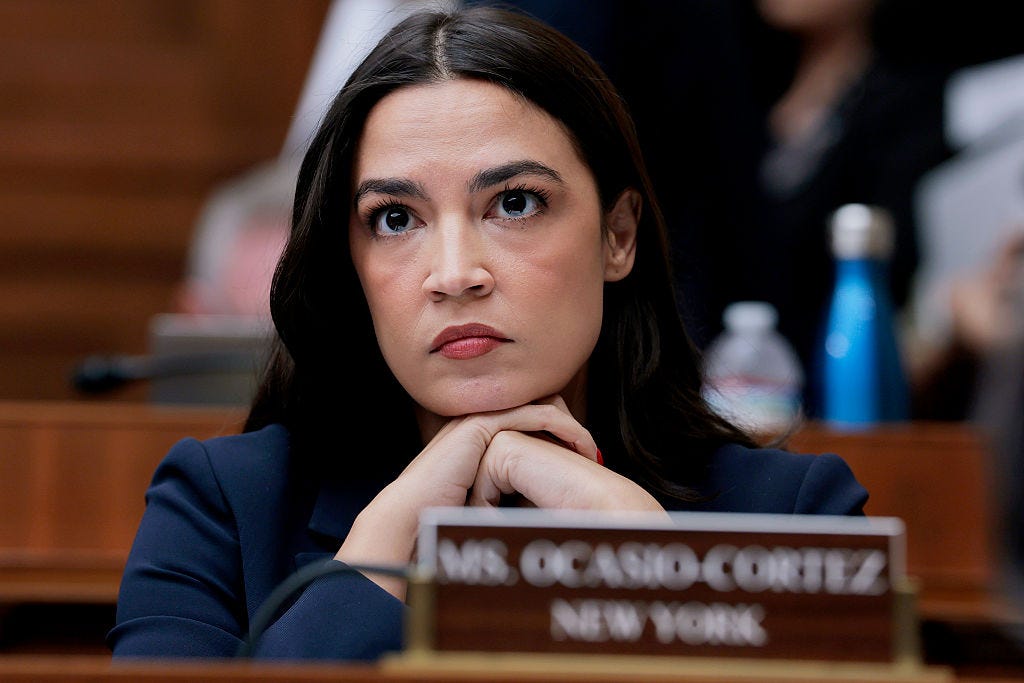
This is part four of my in-depth portrait of the rise of Alexandria Ocasio-Cortez. (Find the first installment, and the series introduction, here. Find the second installment here. Find the third installment here. Today’s chapter looks at how, during her first term in Congress, Ocasio-Cortez learned when to engage in combat — and when instead to play the inside game.
Special thanks to my publisher, Alfred Knopf, for permission to unlock this for Ink readers. This report first appeared in my book The Persuaders.
The rise of AOC: Part 3: Outside, in
She took a risk in opposing Amazon’s bid to locate a new headquarters in New York, in the shadow of her district. A risk because the Amazon site would supposedly have generated many jobs. But she saw the giant tax breaks local officials had offered the company and came out swinging. She told me at the time, for an essay in The New Yorker, that the deal was “dressed-up trickle-down economics.” “What we’re seeing here is a complete public cost for a private corporate benefit,” she said. “When you give a three-billion-dollar tax break to the richest company in the world, that means that you’re giving up our schools. You’re giving up our infrastructure. You’re giving up our community development.” Eventually, Amazon withdrew from the deal. It was later reported to have dramatically expanded its workforce in New York, without any tax breaks needed.
Ocasio-Cortez also began to make waves in legislative hearings, in particular with a rotisserie grilling of Michael Cohen, Trump’s former lawyer, in late February. Thereafter, several of her committee-hearing moments went viral, revealing, once again, her talent for accommodating disparate qualities: she was the diligent student who had done all of her homework, and she was the performer who knew how to create a moment millions would watch. “A lot of people expected a show pony. But it turns out she’s a workhorse,” Caroline Fredrickson, a longtime legal operative in official Washington, told The Guardian.
In parallel, she proceeded with her bear poking. On a visit to the South by Southwest conference in Austin, she called capitalism “unsustainable” and “irredeemable” and did not mince words about the more incrementalist approach associated with many of her own Democratic colleagues. “This idea of like 10 percent better than garbage shouldn’t be something we settle for,” she said. When challenged about her use of the label “democratic socialist,” Ocasio-Cortez did not back down or try to soften her views. “When millennials talk about concepts like democratic socialism, we’re not talking about these kinds of ‘Red Scare’ boogeyman,” she told Business Insider. “We’re talking about countries and systems that already exist that have already been proven to be successful in the modern world.” She called Trump a “fascist” before many members of Congress would, and referred to the border camps where his administration had directed the separation of families as “concentration camps.” Once again, an increasingly familiar loop would play out. She would go online to defend her provocation. Outrage would swell among her critics. And then some serious people would weigh in, having her back. In this case, the Holocaust Memorial Museum in Washington, D.C., put out a statement condemning her use of “concentration camps.” Soon afterward, though, hundreds of scholars organized to sign a letter taking her side of the argument. In this case, it was hard to accuse her of taking the provocative stance for demagogic purposes, because just 25 percent of Americans agreed with her use of the term, according to a poll. But that didn’t seem to matter. For good measure, around that time Ocasio-Cortez also suggested that the Department of Homeland Security be abolished.
She showed a prodigious talent for insults and clapbacks, hitting back at people in a way that stoked her fans’ ardor but was, for many, out of keeping with the way a member of Congress operated. When Ron DeSantis, then a Florida congressman, called her “this girl, Ocasio-Cortez, or whatever she is,” she fired back: “Rep DeSantis, it seems you’re confused as to ‘whatever I am.’ I am a Puerto Rican woman. It’s strange you don’t know what that is, given that ~75,000 Puerto Ricans have relocated to Florida in the 10 mos since María. But I’m sure these new FL voters appreciate your comments!” An affirmation of ethnic identity, a statement of female strength, and an electoral threat, all in one! Another day, she pushed back against Fox News: “1. @ FoxNews, why can’t any of your anchors say my name correctly? It’s been 5 months. 2. It is bizarre to see 1%-salaried anchors laugh at the US housing crisis.”
Ocasio-Cortez explained the ferocity of her style to one interviewer as “a Bronx thing,” part of a “call-and-response culture, which is very much in the wheelhouse of people of color. There is a certain amount of street cred that comes with being able to cleverly defend yourself.” Even in the moment, pundits of long standing felt they were seeing something novel. “It’s kind of amazing that one of the most naturally talented politicians to emerge in some time also happens to be a highly effective, aggressive, and rather merciless combatant in social media messaging,” the journalist Glenn Greenwald had said even before her primary victory. “What I think is fascinating about AOC is how differently she views the upside and downside risk of public presence,” the MSNBC host Chris Hayes said. “Most politicians don’t actually want a lot of attention because it brings scrutiny. AOC takes a very different approach, and one I think we’ll see more politicians take as time goes on.”
In her conversation with Ta-Nehisi Coates in the January of her swearing in, she addressed the matter of the clapbacks and combat. How, he asked her, did she decide when to engage?
“I had some of our organizers ask me this, and I told the joke that basically it’s like, whoever’s coming at me in my mentions with a blue check when I haven’t eaten in three hours,” she said with a laugh. Then, more seriously: “When a really good example comes up, that’s when I do that, because when I clap back, it’s not just reflexive, self-defense. I’m trying to dismantle some of the frames of misogyny, classism, racism that we’ve just allowed to go on. And I wish I didn’t have to do this, to be frank.” For her generation, civility and comity had helped to uphold systems of injustice and hadn’t delivered much besides forever wars, fragile employment, and foreclosures. “Sometimes I just feel like people aren’t being held accountable,” she told Coates, “and until we all start pitching in and holding people accountable, I’m just gonna let them have it.”
Her straddling of these multiple, even at times contradictory persuasive approaches boggled the mind: provoking, patiently teaching, constructing moments, shifting norms, clapping back, baring herself as a lure for her policy ideas, calling out her own side, summoning and boxing in at the same time. All of this reflected, it would seem, an acute and unusually adept understanding of attention in the new era and how it could be marshaled for persuasion.
“They used to talk about the Oprah effect,” the progressive economist Stephanie Kelton told a reporter. “I think it’s the Ocasio effect at this point.” The German newspaper Die Welt summed up her powers thus: “The Walking Provocation; Alexandria Ocasio-Cortez is many things: for the Democrats a star, for the Republicans a spectre of terror, for everyone else the face of a modern campaign.” And all of this attention, it should be said, came with terrifying and awful side effects. Suddenly there were fake nude selfies of Ocasio-Cortez online, being amplified by big publications. Suddenly a Coast Guard lieutenant and avowed white nationalist was arrested in Maryland for threatening to kill Ocasio-Cortez, Pelosi, and the then Senator Kamala Harris. Suddenly Ocasio-Cortez was among the chief targets of the right-wing media machine.
In one of our conversations, I asked her about the development of her talent for seizing attention and using it politically. Her hero Sanders, I suggested, pursued a persuasive strategy built on consistency and purity—saying the same thing the same way a thousand times and refusing the media games and sound bites and crafting of viral moments. She, ideologically aligned with him but of another generation and another temperamental mold, had been more willing to play those games, to employ a wider array of tactics in service of the same fundamental strategy.
“For me, where I’ve landed so far, at least at this moment,” she said, “is that I don’t compromise on my values, but I’m willing to compromise in how we get there, how we talk about them, if it doesn’t undermine the ultimate value and the ultimate goal. I think that’s very different than saying it’s my way or the highway.”
She made a revealing distinction between Sanders and her on this score. He was an older white man whose aloofness the society tolerated, even if it didn’t quite love it. He could refuse the corporate media game, the attention game, the sound-bite culture, the self-revelation (though he was doing more of the latter). But, Ocasio-Cortez told me, “especially for people of color, in order to survive and thrive, you have to find open pockets to exploit and subvert in systems that weren’t intended for your success.”
She gave the example of corporate-owned media as a system that Sanders had generally deplored and avoided and that she, while sharing his attitude toward it, had decided instead to seek to commandeer for her ideas’ benefit. “Media, for the most part, is a for-profit engine and relies on profits in making editorial decisions. That’s why, for example, climate change never got covered in a serious way. Because it wasn’t profitable. They couldn’t figure out a way to tell this story that would drive ratings they could sell ad revenue on.
“It’s not the fault of journalists,” she went on. “It’s just the business structure. You could take a conspiratorial approach to it and say, ‘The media isn’t really doing this.’ Or you can just understand it. I’m like, okay, this is the state of things.” The media is ratings-obsessed. It needs drama. That is what it is. You can turn away as a result, in the way that Sanders tended to. Or, in the way Ocasio-Cortez was now practicing, you could harness everything that was wrong with the media to hijack it to advance your broader goals.
“What I kind of figured was like, ‘Listen, that is a battle, but that’s not the central fight. We aren’t organizing an entire movement for the purpose of dismantling CNN,’” she said.
I suggested that, contrary to a figure like Sanders, she saw the media game she deplored as a game she could also win.
“I see it as a game I can play,” she said. “Climate change, historically, is not an issue that has been addressed, because it had low ratings. Given the fact that I knew at the time that I had been turned into this firebrand and this lightning rod, I made the conscious decision—because, yes, climate change is the existential threat of our time—that if I could use that intensity of attention, for better or worse, and direct it toward climate change, it will force a conversation.”
That idea helped crystallize one difference between Ocasio-Cortez’s persuasive methodology and Sanders’s. She, too, was animated by principle and strident and full of ambition. But where Sanders had reaped real credibility by refusing to descend into the morass of the political culture around him, had built a movement through renunciation, she wanted to use the media against itself, play the pop culture games in order to make the boring interesting and the ignored unignorable. She knew the system was broken, as he did. But she identified as a woman of color who couldn’t afford to yell, over and over, that the system was broken. Instead, she would find the cracks and work inside them. She couldn’t afford to wait for people to come to her because of her truth. She was willing to come to them. She understood them to be bored, stuck in routines, full of apathy, fatalistic about things changing, not dialed in to politics 24/7. And she was willing to assume the burden of making them pay heed. Sanders often seemed to feel that any capitulation to the reality of how political persuasion happens in a democracy—broadening his approach to include self-disclosure, emotional appeal, courting of the press, updated terms on race—was a betrayal of his integrity. Ocasio-Cortez, building on his legacy, was trying something different: playing the game to overturn it; being human and personal for the sake of dismantling structures; meeting voters where they are and challenging them at the same time.
Ocasio-Cortez was perhaps reaching for a new model of leadership for the social media age. On this model, the leader didn’t merely operate within the realm of politics, trying to implement what people wanted. She doubled as a cultural worker, seeking directly to shape the conversation that in turn shaped what people wanted and what, therefore, could be implemented. To be sure, there have always been leaders with the power to galvanize the public around ideas. But in earlier eras, they went through gatekeepers who ran their ideas on op-ed pages and Sunday television shows. They didn’t have a many-times-a-day portal into millions of minds. The new technological realities of office had created a new way of operating that helped to explain Ocasio-Cortez’s juggling of approaches and tones. You provoked to make people think and talk. You wooed to get colleagues to sign on to your plans. You proposed to give the people what they wanted, but you also challenged the people to want things they didn’t yet want.
In her conversation with Coates, Ocasio-Cortez elaborated on this philosophy. “Part of the responsibility—if we’re doing the job right—is to translate public will into the actual law of the land,” she said. “But who shapes and directs and moves that public will is writers, journalists, activists, and artists. They shape the public will and bring it to a point where we can take it and translate it into policy. Without that public will existing first, it’s very difficult to move the nation forward. People think of elected office as being a leadership position, but I don’t think it is. I think it’s a position of following, because oftentimes it’s only when things are made politically expedient, or politically inconvenient to disagree with, that you actually start seeing this movement happen.”
But she was underselling herself. This idea of leaders being hemmed in by public opinion might have applied to others. But Ocasio-Cortez was really trying to do both things at once—to be the influencer and the influenced at the same time, the activist and the acted upon, the bomb thrower and the legislator trying to eke out progress. In an interview on NPR about the Green New Deal, she said, “If I had to decide, would I rather have the resolution passed or would I have rather preferred we start a national conversation about the urgency of the climate crisis, I would have chosen the latter every single time.” It was a vision of persuasion oriented toward the long game, at peace with not even being around when your triumph finally comes, and grounded in the notion that whoever sets the terms and boundaries of what people are talking about will carry the era.
“My job is to bring up things that everyone’s trying to talk about which powerful people are trying to quell,” Ocasio-Cortez told me. “It’s also a different understanding of what my job is from others’. The reason I have the freedom to do this is because I have given up attachment to this idea of a future in politics, which has been very liberating. I literally came in, and I said, ‘You know what, if it’s one term, it’s one term. Let’s roll.’”
After Ocasio-Cortez’s splashy debut on the international stage, the question that hounded her tenure was whether someone pursuing this approach could survive and be granted the space and mercy to navigate it. The isthmus she was walking was narrow: to the establishment on her right, she was at constant risk of being an outcast; to the avid base on her left, she was at constant risk of being a sellout. She was treading carefully. It was grueling and full of risk.
The society rewarded the establishmentarians who stuck to the inside game and clung to their civility and never changed much but leavened stasis with a smile— lavishing them with money and power and office. In a different way, it rewarded the purists, the callers out, the activists who never backed down, with respect, with devoted fan bases, and, more and more, with audiences who would crowdfund their Patreon and give them an independent living. Ocasio-Cortez’s rise was a test of whether the society could reward someone who was unwilling to let the duty of outreach compromise all that she wanted to change, but who was also more interested than many of her activist ilk in winning people over to her visions and translating them into collective reality.
It was a question that went back to the Bronx and Yorktown: Could you, could she, be both?
In those opening months of her tenure, the political establishment tried to make sense of her, and she, of them. After all the drama with Pelosi, Ocasio-Cortez was eventually granted a seat on the high-profile House Financial Services Committee, which oversees the moneyed industries that were a focus for her anger. It was a sign that the establishment types valued (feared?) her powers of calling out and ability to generate viral moments and were perhaps even willing to risk ire from industry. At the same time, colleagues were reportedly seething—unlike her, anonymously, as ever—about how she had sought a seat on the House Ways and Means Committee, the all-powerful body that writes tax laws, and how her army of online fans had swarmed to lobby Pelosi to give her the seat—her failure, in other words, to work the inside route, to ask humbly. “It totally pissed off everyone,” a Democratic House member told a reporter. “You don’t get picked for committees by who your grass-roots [supporters] are.” You don’t, the member was saying, play the outside game.
Ocasio-Cortez was hard for many of her colleagues to read. Was she here to help them or hurt them? One day she was the lone Democrat to vote against reopening the government, because the giant bill contained funding for Immigration and Customs Enforcement, which she wanted to abolish. “Our community felt strongly about not funding that,” she said by way of explanation, refusing the kind of accommodation to reality that was customary in those chambers. Another day, she happened to discover that, in her new environs, lobbyists pay people to stand in line outside committee rooms so they can reserve a spot in hearings. As with the Harvard orientation, many members before her had become aware of this practice, and many of them probably didn’t love it. But she took it upon herself to take a picture of the line and tweet about it, calling out her own workplace. She made a splashy public endorsement of an all-women list of progressive candidates, including a Senate candidate who was running against the preferred candidate of the party bosses. But then, at the same moment, she was offering her colleagues complimentary Twitter classes to teach the AOC way. The seminar highlighted “the importance of digital media storytelling,” according to an invitation sent to members, and promised instruction on how to use the platform “as an effective and authentic messaging tool.”
What she was teaching was what she had mastered herself—the building of a direct and loyal and constantly watered connection to one’s followers, so as to create a power base that no one could take away. To achieve this was a mark of independence in this time, not only in politics, but also in media, where social followings and solo newsletters became the order of the day, and among young creators, who built multimillion-dollar businesses out of “hype houses” where they made TikTok videos about living in hype houses making TikTok videos. The soloist approach to persuasion relied heavily on the star’s ability to marshal public opinion. But in the realm of politics, it left many insiders feeling bypassed and dissed, because their power was being threatened.
In April 2019, three months into her first term, Politico ran a revealing article titled “How Alexandria Ocasio-Cortez Broke All the Rules of New York Politics.” Filled with the petty grievances of local pols, it is a reminder of how unusual Ocasio-Cortez’s inside/outside-game approach was:
Power in New York has not traditionally been achieved through social media stardom; it has been achieved through the slow and painful courting of various constituency groups. It is achieved block association by block association, community board by community board, labor union by labor union. Now that she is a star, city insiders wonder, is AOC willing to labor in those trenches? Does she even need to? What happens if she doesn’t?
Part of the anxiety was simple jealousy. “I send a tweet when I see something I think is cool, and it gets, like, six likes,” one state senator was quoted as saying. “AOC sneezes and it gets a half-million retweets!” Part of it was the fear of getting in the crosshairs of someone who had not merely the power to draft a bill or call a hearing but also the more immediate and visceral power to drag you online. The article quoted a slightly irked Al Sharpton about his disappointment that Ocasio-Cortez had skipped his annual Martin Luther King Day party in Harlem, where insiders of every variety come to play the inside game by courting the reverend, in favor of that public event with Ta-Nehisi Coates, where she was instead taking her case directly to the public, via a video stream. The fear that threaded through many of the comments in the Politico article, often anonymous, was that Ocasio-Cortez’s reliance on, and facility with, the outside game would free her from the necessity of making relationships with movers and shakers in power—free her from the need for them. “I say this not to dismiss her,” one political type was quoted as saying, the caveat somewhat unconvincing, “because I think she is really smart and capable, but it is like if Kim Kardashian were a member of Congress. Do you think she would be going to community boards? Why do the scut work of local politics if you can get glossy magazine covers?”
The other rap on Ocasio-Cortez’s approach in those first months was that this ascendant influencer politicking was fundamentally anti-coalitional when it came to relationships with other legislators. Calling out and staking out window-moving positions were useful for building and revving up a following. But there was a risk of writing off people with valid reasons for hesitancy as corporate stooges or cowardly. “The demand to deny committee seats to anyone who takes money from people in the fossil fuel industry, while useful for brandishing moral superiority, further weakens the prospects for coalition-building,” Politico, ever the mouthpiece for the Beltway establishment, had written in another critical report earlier that year, this one on Ocasio-Cortez’s climate proposals. The article suggested Ocasio-Cortez was “more focused on building an audience than building cases for her positions among her congressional peers.” There was that tension once again: the audience was what gave her power, and it was what had made all those presidential candidates embrace her Green New Deal. But what it took to provoke and use attention risked turning a lawmaker into a flattened character of their own authorship, more strident and less forgiving than they actually were, and less effective at translating their own recipes into sausage.
By her first summer in office, the message of some of these criticisms seemed to break through and chasten Ocasio-Cortez. “Alexandria Ocasio-Cortez learns to play the insider’s game,” the ever-anxious Politico now declared. She had tried working with Speaker Pelosi to alter legislation funding enforcement on the Mexican border. Ultimately, it didn’t go Ocasio-Cortez’s way, and she voted against the bill she had sought to change. But, Politico noted approvingly, contrary to expectations on the Hill, “Ocasio-Cortez held no impromptu news conference on the Capitol lawn. She refrained from a tweetstorm. In fact, she didn’t write a single post about one of the biggest immigration debates so far under the Democratic majority.”
So maybe, in the eyes of the Beltway establishment, she was finding her footing on the isthmus. And then, in the middle of the summer of 2019, before more such articles could be written, there was another Pelosi flare-up.
Speaking to Maureen Dowd of The New York Times, Pelosi dismissed Ocasio-Cortez and her fellow members of the Squad. “All these people have their public whatever and their Twitter world,” Pelosi said. “But they didn’t have any following. They’re four people and that’s how many votes they got.” She was not just minimizing the achievements of several dynamic new women of color in Congress. She was railing against the theory of change that Ocasio-Cortez had articulated in the conversation with Coates—the inside-outside, influencer-legislator approach of a new era.
Ocasio-Cortez was angry. She tweeted, “That public ‘whatever’ is called public sentiment. And wielding the power to shift it is how we actually achieve meaningful change in this country.” It was an instructive collision of worldviews, the inside-inside and the inside-outside games in battle.
Was she a renegade, or had she made peace with the system? Reporters couldn’t decide. That fall, Catie Edmondson of The New York Times concluded that Ocasio-Cortez had “learned to play by Washington’s rules,” declaring that she had “tempered her brash, institution-be-damned style with something different: a careful political calculus that adheres more closely to the unwritten rules of Washington she once disdained.” The article itemized some concessions on her part—standing down from supporting primary challenges to some senior Democratic Party leaders; inviting her social networks to send money to centrist Democrats in tough fights in red places. But the report was also instructive about institutional Washington’s assumptions about what an effective legislator is. “When she first arrived on Capitol Hill, Ms. Ocasio-Cortez and her team made it clear they planned to use their perch inside Congress as a platform for their divisive, outsider brand of politics,” Edmondson wrote. The way “divisive” and “outsider” were stacked one on top of the other was revealing. “The approach that she and her cohorts champion—pulling the institution to the left in part by threatening the careers of any Democrats who fail to embrace their ideas—quickly alienated many of her colleagues, and has made it difficult for her to get anything done,” the article said. But Waleed Shahid, the Justice Democrats communications maven who had helped her first campaign, had a more nuanced view. Contrary to the pundits and reporters determined to understand whether she was done with the outside game and ready to come indoors, he reminded people that Ocasio-Cortez remained simultaneously committed to both. “Navigating her role as a legislator and a movement builder is basically what her career is about,” he told the Times. “We’ll continue to have that theory of change with one foot in D.C. and one foot in the movement. It’s really hard to do that.”
Later, when I asked Ocasio-Cortez what lessons she had drawn from the year of her arrival, she said, “In terms of my learning style, I’m very much an observer. I kind of hang back and I watch a lot of dynamics play forward before necessarily inserting myself, which is very different, actually, from my outside game. My outside game, I’m willing to just throw a bomb and say, ‘Okay, let’s see how this goes.’ Because I think that that’s what’s necessary in shifting public conversation. Behind closed doors, I try to chart out— and this is also the way organizers do—there’s a tactic that organizers use called power mapping. And you essentially start mapping out relationships and nodes of power, almost like this web or this network in your mind. Some people do it physically on paper.
“And that’s a lot of the work, the inside work that I think I tried to do, is figure out the power map, figure out unusual alliances. Try to find areas of vulnerability that can be leveraged to create pressure on leadership.” She added, “There are a lot more people that are cajoleable than many would think at first blush. And many people shift on issues because there’s some people that just go with the tide and they just run with the wind. Sometimes that’s a really bad quality, but sometimes it’s a quality that you can harness in your favor, if you determine where the wind blows.”
She thought of herself as power mapping on the inside but not for the inside’s sake, in the way of the old boys’ club. She was mapping the inside for those on the outside.
She was walking the isthmus. But in mid-October 2019, when at last she made her choice in the presidential primary, pressing her celebrity and legions of followers into the service of the Sanders campaign, she was also planting her flag. She might pull her punches from time to time, she might hold her fire, but she was bent not merely on reform but on a “political revolution.”
Ocasio-Cortez’s allies on the left, some of whom had begun to chafe at the stories of her capitulation to the capital’s ways, cheered. Jacobin, the socialist magazine, wrote, “Placating party leaders will do little to help Ocasio-Cortez achieve the kind of transformative changes she wants. She seems to understand this.” Politico, unpacking the differences between Senator Elizabeth Warren’s vision of saving capitalism from itself and Sanders’s vision of democratic socialism, wrote of Ocasio-Cortez’s endorsement that she “has chosen to remind everyone of which side she’s on.”
And yet she and Sanders continued to have their own approaches. She cultivated her own image and connection with voters in a way Sanders never cared to. And some of the anxiety that she caused among her own leftist supporters—an anxiety that was quiet at first and then grew louder—involved what she was willing to barter away for the sake of that wooing of the broader public. A question that hovered over her tenure and over the left more generally was whether her own allies would trust her to fight their fight in whatever ways she saw fit or whether, every time she tried to broaden the appeal of the ideas she fought for, they would seek to brand her a phony.
In that season of her arrival, Ocasio-Cortez was most visible for her punching right at centrist Democrats and Republicans and her moving of the Overton window. But throughout, with less fanfare, she was also making a case to allies on the left to trust that what might at times seem like capitulating to the game was actually a bid to win the game—to win, as Faiz Shakir put it, by growing. Yet it was a complicated case to make because those who really did capitulate often said the same thing.
Ocasio-Cortez found herself having to make this case when Senator John McCain died and she decided to put out an anodyne, almost form-lettery tweet: “John McCain’s legacy represents an unparalleled example of human decency and American service.” Immediately she came under attack on the left for memorializing a war hawk. And she fired back at her leftist critics: “We need to look at: Have the commitments changed? And I don’t think my commitments on any of these issues have changed at all. It’s one tweet, after a multi-decade public servant passed away—does that mean I’m no longer an anti-war candidate? That’s a ridiculous assumption to make.” And yet the word “unparalleled” did, perhaps, sound unlike the Ocasio-Cortez her allies had fallen in love with. To some ears, it had the quality of a coded message in a hostage video, signaling her capture by the institution. Ocasio-Cortez wanted those critics to know that you could try to meet, in this case, an institution where it is and still be a true believer. She told a reporter at the time, “I welcome the criticism. But we need
to look outward, too. We need to bring people in.” She was setting up an opposition between this intramural criticism and an expansionary pursuit of support. Though she was beloved in her district and by her ideological base, she had high negative ratings among more moderate and conservative voters. A statement like the one she had made was the kind of gesture that might make some of those people think she was okay, a little provocative, but fundamentally okay, heart-in-the-right-place kind of thing, and that was helpful if you were trying to sell the country on an agenda of upending the society. Ocasio-Cortez
wanted her followers to trust her on when to play by the system’s rules and when to break them. But how was one to know when playing by those rules simply overtook a lawmaker, as it had so many? And did the kind of outreach the tweet might have attempted even work? Was it worth the risk of making some in her base cringe to speak to a broader constituency?
There had been a similar kerfuffle when Ocasio-Cortez attended an evening at the residence of Audrey Gelman, the entrepreneur who founded the Wing, an exclusive members-only work space for women. Ocasio-Cortez came in for criticism, and she asked her supposed allies on the left to be more like people on the right who “support their candidates no matter what.” She clarified that what she longed for was the faith people on the right have in their leaders, but coupled with a real accountability the right lacks. She understood the anger of those who “rolled their eyes at what they saw as a blatant co-opting of the insurgent left’s popularity by capitalist entrepreneurs,” as Raina Lipsitz put it in The Nation. And it was important to be vigilant to avoid becoming compromised. But, she told Lipsitz, that hankering for accountability on the left risked destroying any maneuvering room Ocasio-Cortez had to expand the appeal of her ideas. As Lipsitz wrote,
Organizing, she notes, is about persuasion, and bringing people—all kinds—closer to supporting your goals. “Being an organizer is very core to my identity,” she says. “And I think it’s a word that gets thrown around, and people don’t really understand what [the] tenets of organizing are.”
“How are we going to achieve the things that we want to achieve if your [average] young, upwardly mobile professional woman doesn’t realize that she’s part of a class struggle, too?” she continues. It’s crucial for the movement “to build power everywhere.”
“Does it mean that The Wing is going to deliver the revolution?” Ocasio-Cortez adds with a smile. “No. But it also means that we can’t constantly be rolling our eyes at every person that goes to Starbucks.”
She wanted to be accountable to her base, to cultivate some of the ardor she herself had felt for Sanders, an ardor born of his purity and the indubitability of that purity. But she wanted, moreover, the trust of her base to map the equations of power and reach out without being called out for capitulating. She wanted, as ever, to be both. “She’ll always be uncompromising on the vision,” her friend Jean-Bertrand Uwilingiyimana told a journalist. “The tactics which get the party to that vision, she’s pragmatic on.”
It was this philosophy, and her own grappling with it, that seemed to lurk behind her advice to Sanders fans in the spring of 2020—“to listen, to adapt, to open a posture of acceptance.” To win by growing, to use the system against itself, and—here was the important part—to trust one another.
When Sanders lost that campaign, and Joe Biden, the kind of Democrat Ocasio-Cortez had launched her political career to challenge, won, it ushered in another test of her approach. The challenge was no longer to broaden the appeal of a set of (for America) radical political possibilities. It was to push a historically moderate and cautious and bipartisanship-loving candidate to be bolder than history or instinct told him to.

I hope that these writings help people to see how valuable she is. Thank you.
Glad your publisher allowed you to excerpt your book, I ended up buying the book because of the excerpts, I wanted to read the rest.