


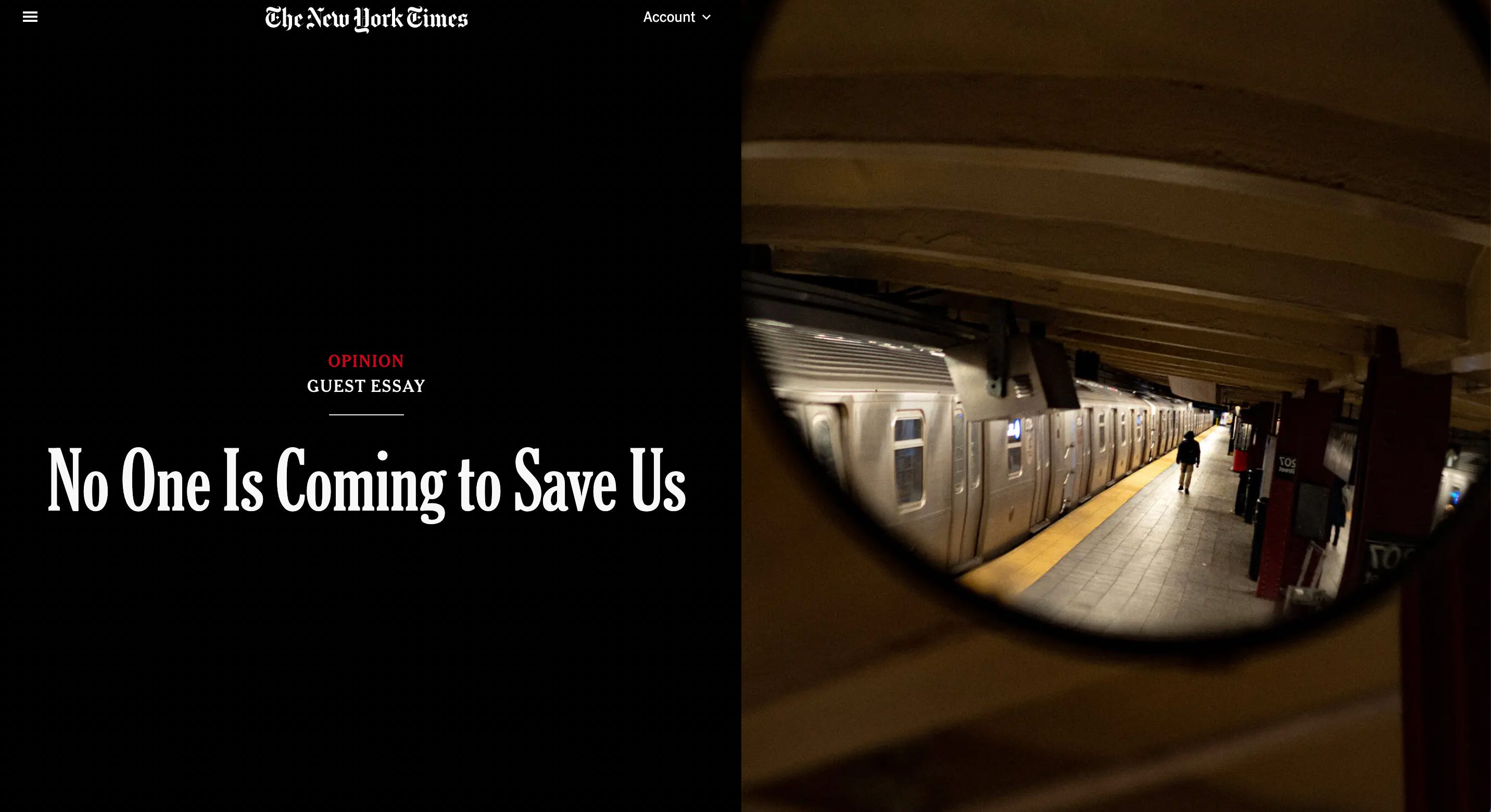
The short version: The New York Times is running a guest essay today by yours truly, based on my new book, MAN IN THE MIRROR. It’s about how a tragic subway killing that divided America actually revealed what we have in common.
Now, for those of you who like a little context stirred into your coffee, here’s a splash.
The first time I had the feeling, I was 17. I was a high school kid who had somehow talked himself into an internship at The Times. My boss, an editor in the Washington bureau named Jill Abramson, told me to report and write something. I suggested that might not be a good idea, because…17. But she insisted, and I did. And I remember sitting on my parents’ bed the night the piece was closing, and the copy desk calling me with edits, and the piece closing. And the feeling — that came the next morning when I went outside to bring in the blue bag. It was a magic trick to me, the only one I ever wanted to learn. I wrote it on my laptop, they called me with some repairs, and then it was in the blue bag in my front yard.
Some years later, I was lucky enough to embark on an 11-year stint writing for The Times. I learned everything about journalism there. It’s Parris Island for people whose idea of a pull-up is pulling up to a reluctant source’s house to see if they will talk.
And now I write something for The Times a few times a year at most. But the feeling, I will tell you, doesn’t go away. The magic trick.
So when I have a new book to share with the world, it’s a special honor to get to bring it to a broad audience of Times readers with an essay like today’s. And the 17-year-old boy buried in me is very thrilled to see it.
I talk a lot on here about the power of independent media — like this thing right here. But I have to tell you, it is a powerful and special experience to be edited the way a piece like today’s essay was. The legendary Vanessa Mobley is my editor. She used to be a book editor, now works at The Times. She is as fastidious and obsessive as I am, and doesn’t mind going three, five, eight rounds with me, back and forth, back and forth, until we cook it just right. Then several other editors weigh in, make tweaks, adjustments, suggestions, additions. Everyone in the Track Changes, a kind of ballet.
As much as I enjoy going it alone in a newsletter, I have to admit that this kind of process makes for powerful, lasting work. Or so I hope. (The same goes for books, by the way, and my wonderful team at Knopf.)
That’s it, that’s the context. I would love you to read this story, share it with people you know. In fact, if you’re able, send it to five people today. It would help a lot.
And if you haven’t yet, I will say unabashedly: I want you as one of the early readers of MAN IN THE MIRROR. I want you to get in on the ground floor of this work and of all the conversations we will have about it.
And a short preview of the essay here:
For a few moments on May 1, 2023, an extraordinary amount of American life was compressed into one New York subway car.
There was Jordan Neely, a 30-year-old Black man, homeless and suffering from mental illness, frightening passengers beneath a city still shaken by Covid. There was Daniel Penny, a white former Marine from Long Island who put him in a chokehold. There were bystanders facing a dilemma that would feel familiar to many Americans: wait for the system to work; take matters into their own hands; or withdraw. And hovering in the air of car No. 9774 was America’s deepening crisis of trust — in institutions, in strangers and even in the belief that anyone is coming to help.
When Mr. Neely died in that encounter and Mr. Penny was charged with killing him, an American tragedy was instantaneously reduced to an American Rorschach test: What did you see in Mr. Penny, a hero or a vigilante? Was Mr. Neely a victim or a menace? People retreated to their corners and posted before they knew much. Soon the story, having been picked over, fell out of consciousness.
Three years later, the case is worth revisiting for the mirror it holds up to the nation. A death on the subway that seemed to prove that Americans now inhabit perfectly sealed, irreconcilable moral universes actually revealed one of the last things we have in common — abandonment.
A compelling essay. I was reminded of my very first real job as a preschool teacher at Head Start in Jersey City. My eyes were opened to the broken glass on the playground, the concrete outside our door. I once asked my aide why she didn’t call the police after recalling an incident and she laughed. They would never call the police into the projects, it would be inviting more trouble. It was the early 70s, and we’re still waiting for the cavalry to arrive.
Beautiful essay — I’m really looking forward to the book!