


A man sits in a chair looking mournful. His face betrays worry, and, indeed, he is worried, he confesses. Worried about A.I. In this, he is like so many around the world.
Recently, the man says, he went home depressed. This is not the kind of man who radiates emotion, so one takes note. What made him depressed was the acceleration of A.I.’s capabilities, and the man’s growing belief that not only low- and mid-level work but also high-level work will soon be wrested away from human beings.
As opinion polls and several viral videos from college commencement speeches show, the man is not alone in his fear and sadness. Millions share in his fear, understandably, since they are daily riding on trains and highways while being advertised their own coming irrelevance.
What is strange about the video, then, is not the message but the messenger. The man who is worried is no ordinary man. He is Ken Griffin, one of the richest men in the world, a finance magnate who is both an active investor in A.I. and, as he is disclosing in the video, a user of it within his own firm. In the video, Griffin is confessing his depression about trends he is helping cause.
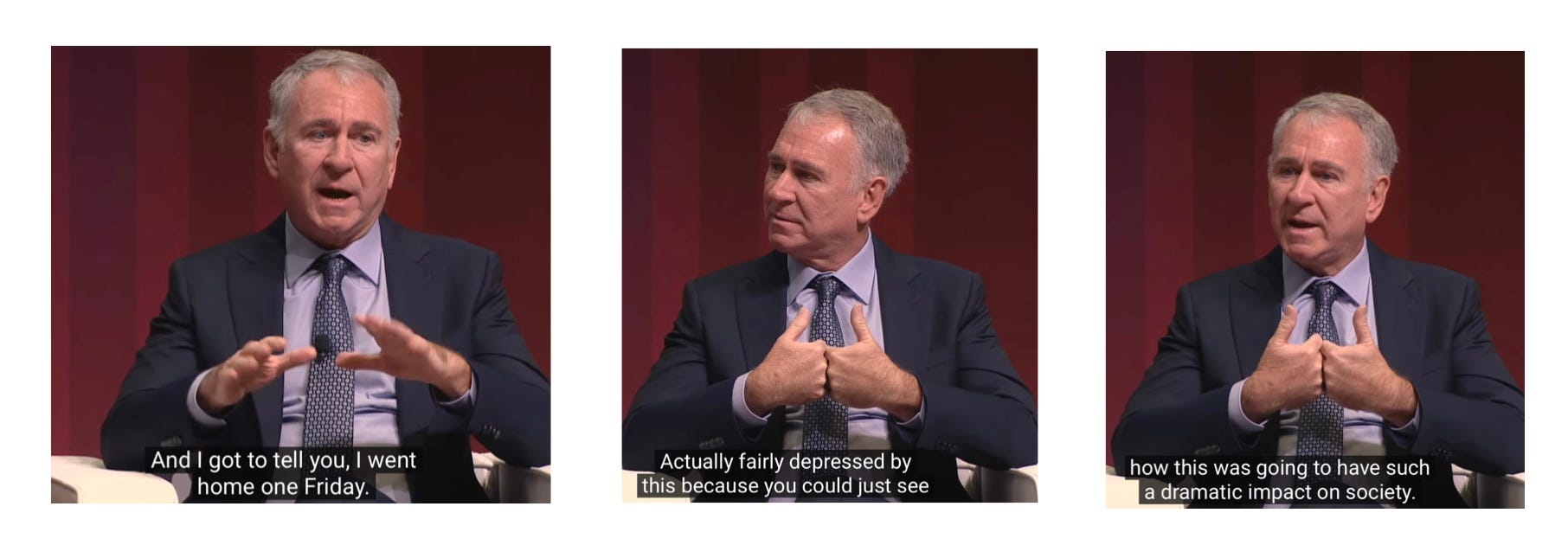
The sadness he describes comes, he says, from applying A.I. tools at Citadel, his firm, in recent months. There has been a “step change” in their ability, he says. He has seen what once took man-years of masters- and Ph.D.-level employees’ time be done within hours and days by A.I. And so Griffin is sad. Sad, presumably, that there will soon be so little use for human beings. The unspoken implication is clear: if there will be so little use for people in that stratosphere — if being a Ph.D. financial whiz at Citadel, working for the Ken Griffin, isn’t safe — what chance in hell do the rest of us have?
Full video via YouTube here.
Something striking is at work here — an oligarch move that deserves to be noticed and named and tracked. Griffin is professing to worry about a future he is himself actively causing, and will continue to cause. He is the one choosing to deploy these A.I. tools in his firm; no one made him. He is the one choosing to invest in A.I.-related companies like Digi Power X Inc. But in a twist on the familiar arc of plutocratic plunder followed by by philanthropic atonement, Griffin is atoning in advance.
He is putting on record that he was sad about this thing that he was also doing. Here he is not “giving back” some spoils later on. He is simply registering that he feels super-bad about it. It hurts his heart. He has grief about his own deeds, in real time.
There is power in this move, because the confession of sadness about job losses, or of worry about other destructive forces of A.I., allows the oligarch in question to pose as a predictor of what is inevitable, when in fact they are a profiteering proponent of this future. To be visibly sad about a thing you are doing can distract people from the doing part and focus attention on the sadness. Generally, we are sad about things beyond our control. So to be sad about what you are causing is shrewd. It can lull people into thinking that we have no choice but to A.I. it all up. It can allow advocacy to draft behind loudly proclaimed predictions. It can frame the instigator of calamity as a kind of armchair expert about calamity.
Griffin has lately gotten into a tussle with the mayor of New York, Zohran Mamdani. Mamdani famously promoted his new idea of taxing the rich by focusing on frequently vacant pied-a-terres with a video outside Griffin’s own pad (pied?). Griffin has fired back, accusing Mamdani of putting him in “harm’s way,” invoking the 2024 killing of Brian Thompson, the CEO of UnitedHealthcare, nearby. And he did what oligarchs often do, which is suggest that by coming after them, tax-wise, a leader is actually hurting regular people. “We will add far more jobs in Miami over the next decade as an immediate and direct consequence of the mayor’s poor decision here,” Griffin said. And he teased a threat that a major redevelopment project on Park Avenue in Manhattan might be on thin ice. However, in a nod to his ally President Trump, Griffin seemed to chicken out of his own threat almost as he voiced it, saying that “we probably will go through [with] the building when it’s all said and done.”
This is a more well-established move. Here the oligarch, whose interests clearly diverge from those of the public, disguises his interests as yours. To hurt him is to hurt the public, really. To tax him is to threaten your jobs. Come for him, and you really come for yourselves. He is you, richer.
In an age of historic inequality, the widespread sense that it is impossible to make life add up, and now the constant promise-threat of technologies that we are being told will make us disposable, this is the oligarchs’ answer. It doesn’t feel too many miles from the rhetoric of an abuser: I’m sad about hurting you even though I’m the one hurting you. If you push back against me, you’re really hurting yourself. There is no choice but to do it my way. You need me.
Whenever people want you to think there’s no choice in a matter, that’s when there is.
I LOVE the analogy of oligarchs and abusers! BRILLIANT! You couldn’t be more on track! I love the way you think!
Anyone who has ever been threatened or abused has witnessed this method of “turning the tables.”
Thank You for identifying this so that we can root it out in our locales.
I feel a wave coming on…