


My dear Ink community,
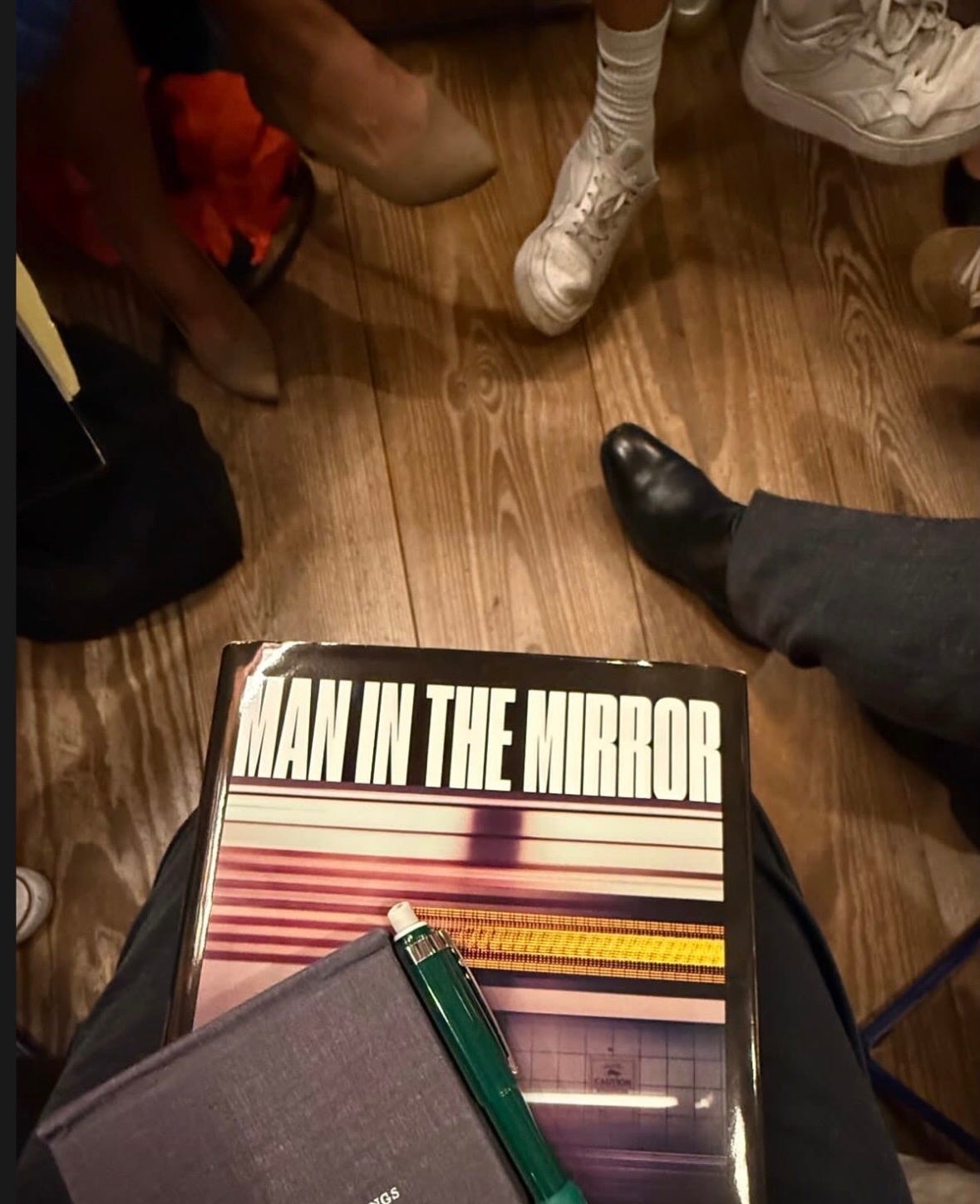
It’s time that we get together. It’s book club time again. By now, you’ve heard plenty from me about MAN IN THE MIRROR. Many of you are already deep in the book, sending me the most heart-warming notes.
Now let’s hang out and process it all together.
Here’s what we’re going to do: Three meetings on Zoom over the next six weeks, to discuss the book roughly in thirds. (We will follow the split used in my in-person book club with the McNally Jackson bookstore.)
So save the dates and register now to reserve your spot in the Zoom. Space is limited.
Tuesday, November 10 at 8 p.m. Eastern (be ready to discuss pp. 1-153, chapters 1-19)
Monday, November 23 at 8 p.m. Eastern (be ready to discuss pp. 154-299, chapters 20-33)
Tuesday, December 8 at 8 p.m. Eastern (be ready to discuss pp. 300-440, chapters 34-45)
We will gather together on Zoom. We will be able to see each other’s faces. We will talk about the book, the country, writing, more.
I’m also enclosing some discussion questions below.
Looking very forward to being with you all.
Anand
P.S. If you haven’t yet taken the plunge, you can order the book here:
It is available wherever books are sold, including: Amazon, Barnes & Noble, Bookshop, Powell’s, Target, Books are Magic, or, for a signed copy, McNally Jackson. It’s available in hardcover, e-book, and audio.
Starter discussion questions
What presumptions did you bring to the subject matter of the book, and how, if at all, has the book challenged some of them?
Who is the character that has most stayed with you, and why?
What do you make of the literary device of seeking to inhabit the consciousness of some of the characters? How does it affect your reading experience? When you end up entering the minds of people you don’t agree with on things, what is that like for you?
The opening chapters introduce you to various players who have various agendas for this story. Why are we spending time with people who are crying to craft narratives?
Which of the worlds depicted in the book do you have some personal experience of? How do those experiences shape your read?
Analyze Johnny’s decision to get off of his antidepressants?
Reflect on the idea of moral complexity, as it appears in this book. Do you find yourself being challenged about the complexity beneath people we judge from afar?
Feel free to begin the discussion here in the comment thread, and we’ll continue live.
I live in France. 8pm for you is 2am for me. Will these be recorded? In the future, some thought for your European fans!! 🤪
I have not finished the first third of the book, but I was at your book launch last month and heard you speaking about it elsewhere. I'm really looking forward to reading this in community and also meeting you at Fountain House in a few days. To your discussion prompt, I am honestly troubled by the whole idea of narrative nonfiction; I doubt I will ever be able to sympathize or withhold judgment from Penny and his supporters. I have experienced homelessness, though I was never street homeless. I live with a psychotic disorder. And I am a homelessness activist. Even so, I would never presume to try to write from the perspective of someone living outside or underground because I have never been in that position. Just as it's treacherous for those of us with a roof over our heads to try to embody the perspective of someone who is homeless, it can be deeply problematic when non-disabled people choose to write about those of us with psychiatric disabilities. I have also been the victim of a hate crime on a crowded subway car by a person who seemed to be having a psychotic episode (nobody intervened). Even so, I would not try to put myself in my assailant's shoes. I'm open to having my mind changed but I had a visceral reaction to how you have framed this project. I think the Neely killing should be understood through the lens of the stigmatization and fear of people with psychotic disorders--like Neely--by people without psychiatric disabilities--like Penny. It seems to me that Neely's murder reveals power differentials that don't support an evenhanded "both sides" kind of analysis.