


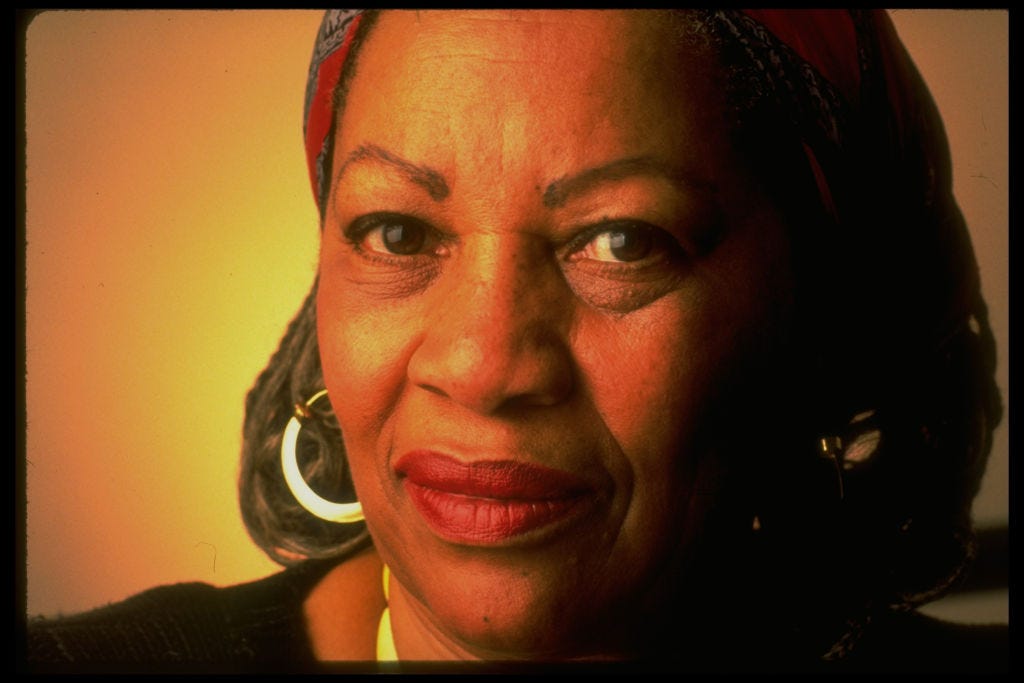
In part two of our Ink Book Club conversation with the author of “On Morrison,” Namwali Serpell, we go on a brief tour of Morrison’s oeuvre. Throughout, we are reminded just how intentional Morrison was in shifting away from the white gaze, and, as a result, breaking new literary ground. It’s also astonishing to be reminded that Morrison was writing the work that would earn her the 1993 Nobel Prize in Literature in the 1960s and ’70s, while raising two boys on her own. During that time, she was also employed as an editor at Random House, and teaching college English.
“On Morrison” opens with an examination of the author’s first novel, “The Bluest Eye.” When it came out in 1970, Morrison was already making her mark as an editor, but still looking for validation as a writer. She had doubts that her debut would earn her the title of “novelist.” But by the time she began writing “Jazz” in the early 1990s, she was no longer concerned with critical reception or reader approval, but with how far she could push the envelope of form.
Together, Serpell’s chapters comprise a master class. Each places a particular Morrison work — arranged chronologically from first to last — beneath a critical microscope, examining how the author’s ideas coalesced around plot, character, history, and style. So let’s dig in with my question-and-answer with Serpell.

“Nobody Knows The Bluest Eye” is chapter one in “On Morrison.” Here you write that Morrison’s novels teach us how to read them, and also “teach us how to write our own stories.” What does “The Bluest Eye” have to teach us?
Banned as it’s been, we know what “The Bluest Eye” is about: a little black girl who wishes she had blue eyes. That’s not a spoiler. Morrison didn’t believe in spoilers. She gave away the whole plot of “The Bluest Eye” in its opening narration: “Quiet as it’s kept, there were no marigolds in the fall of 1941. We thought, at the time, it was because Pecola was having her father’s baby that the marigolds did not grow.” The gossipy tone and the mystery of the missing marigolds divert our attention from those six key words: “Pecola was having her father’s baby.” Morrison immediately obviates the notion that suspense and finding out what’s going to happen are the most important parts of reading. This preface concludes: “There is really nothing more to say–except why. But since why is difficult to handle, one must take refuge in how.”