


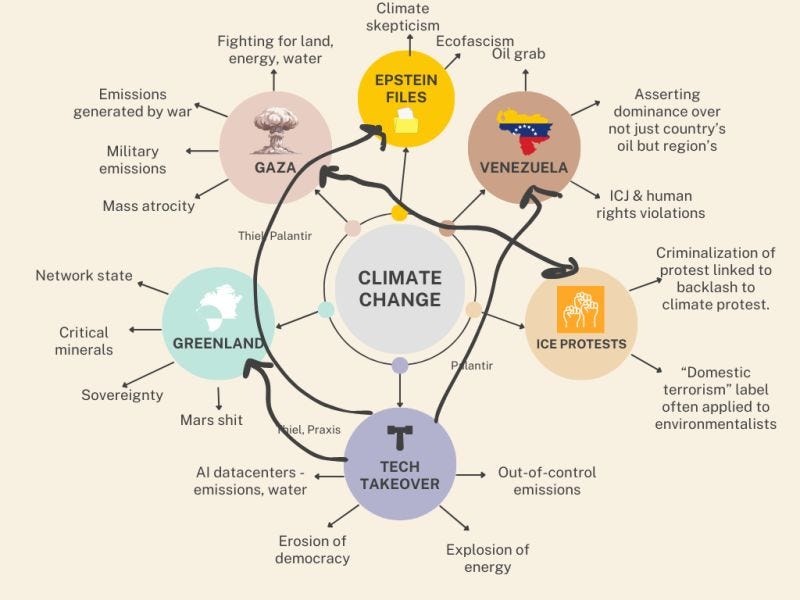
With the expanding war in Iran, economic shock, the A.I.-driven upheaval of everyone’s livelihoods, the machinery of exploitation laid bare in the Jeffrey Epstein files, the ongoing occupation of American cities, and the ever-shifting chaos of Trumpian governance, it’s understandable that even the most attentive readers might not have been paying attention to every crisis — even the very biggest issues that face humankind.
And that, Anya Kamenetz writes, is the nature of the moment: an age of multiple, intersecting, and mutually reinforcing crises, each stealing our focus in turn.
But, she argues, even when it’s all too much, there’s a philosophical way out, proposed by scholar and author Timothy Morton — an argument about handling our perception in a way that lets us look at the small challenges that we can handle in the context of the big issues that are too overwhelming to consider — and lets us address them all, in time.
In other words: Climate change is too big to be entirely solvable, fixable, or endable. Not in the foreseeable future and certainly not right now.
But medium-sized progress is still very much happening as people keep working on problems they can get their arms around.
Read the original essay (and the rest of Anya Kamenetz’s work) over at The Golden Hour.
Thank you so much to our supporting subscribers for making this newsletter possible. If you haven’t yet joined our community, become part of this and help us build the future of independent media today.
We bring you this post courtesy of Anya Kamenetz. Subscribe to The Golden Hour to read all of her work on politics, climate, children, mental health, and much more.

By Anya Kamenetz
Hello friends.
NBC’s top climate reporter, Chase Cain, just resigned. He told independent climate journalist Emily Atkin he was burnt out from fighting to get his stories on air, and sick of being forced to give away the limited airtime he did have to liars in the name of balance.
“We know that oil is making the planet hotter. I don’t need the oil company to lie to me and say that it’s not.”
It’s not your imagination : The silence on climate has grown deafening these past few years. This is happening even as the crisis is actually getting worse more quickly than projected.

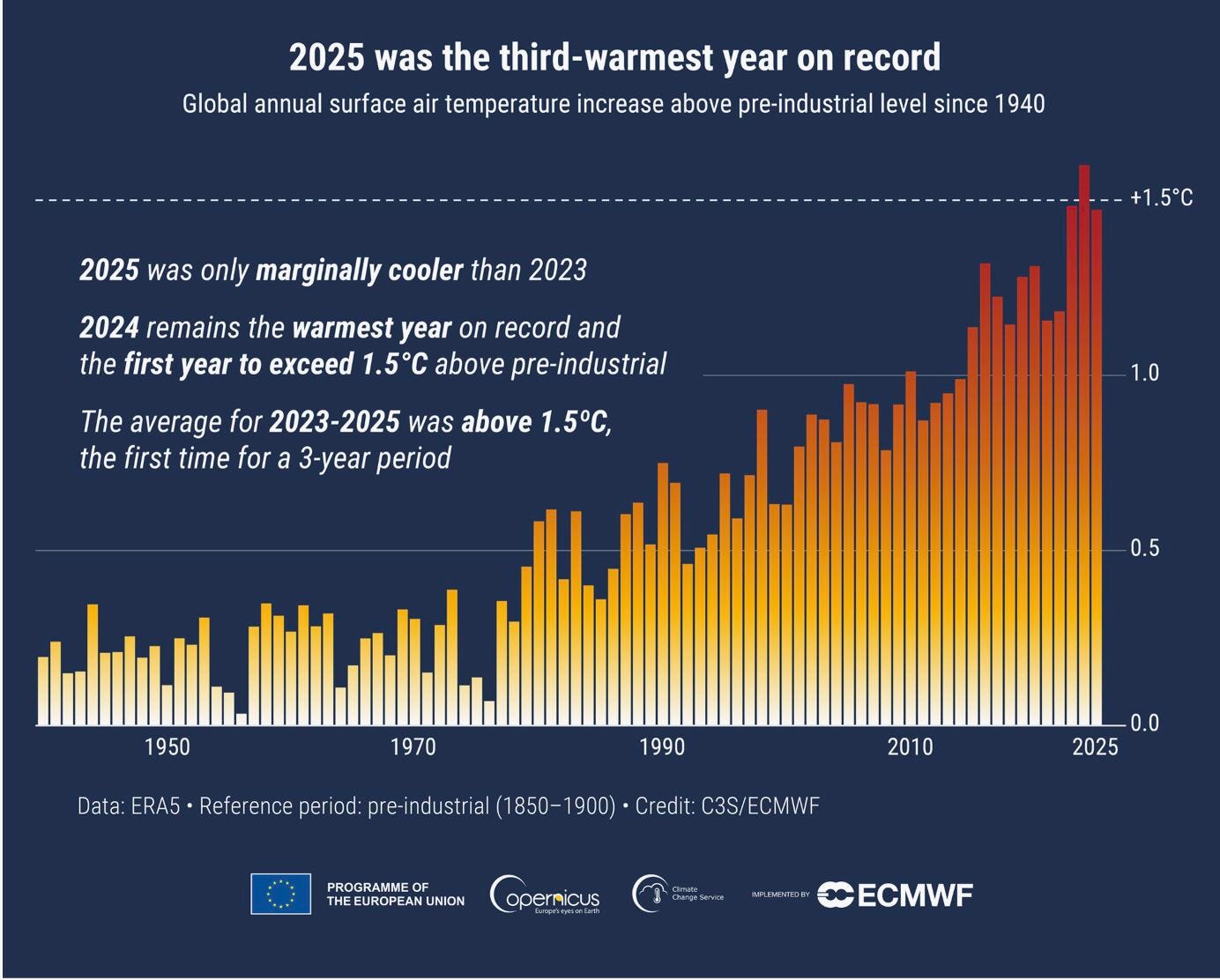
2025 was the third-warmest year on record (2024 being the warmest), with 23 separate weather disasters in the United States each costing a billion dollars or more. Vast neighborhoods of our nation’s second-largest city went up in flames, creating $53 billion in damages. Dozens of children drowned in a flash flood in Texas. And the rate of warning is actually accelerating, according to a new scientific paper published March 6.
Also in 2025, the Trump administration hid and defunded climate data and science. They hired denialists to high posts across the government, obstructed clean energy projects and blocked regulation. Democrats, capitulating to the successful framing and polarization of the issue by the right wing, took part in their own “climate hushing.” The big tech companies that dominate U.S. market value reversed themselves on once-ambitious climate goals, largely because their lead $$ bet is an energy- and water-slurping, job-destroying slop monster: artificial intelligence.
Media? It’s not just NBC. Total coverage of climate has dropped roughly by half since 2023. The Washington Post gutted its climate team this year as part of its continuing Bezos-ification.
Corporate broadcast television networks cut climate coverage for a third straight year in 2025. According to Media Matters, ABC, CBS and NBC spent, collectively, 8 hours and 25 minutes reporting on the single global crisis that most threatens the future of humanity. Per Emily Atkin:
Only 8 percent of all corporate broadcast climate segments mentioned fossil fuels, the main driver of climate change. So even when corporate news networks do cover climate change, they systemically refuse to explain why it’s happening.”
What’s really hard to accept, though, is that it’s not just the government, companies, and the media that are muffling talk of climate. We all are.
It’s not that we don’t care. In fact more than half of Americans described themselves as “concerned” or “alarmed” over global warming in fall 2025, with “alarmed” being the fastest-growing category over the past decade.
It’s that our attention is under siege, and our focus is going with it. The climate organizers I speak with are lamenting privately and publicly that climate is no longer top of mind for anyone—students, moms, Democratic socialists, no one.
In the United States, climate activists, the brave few who have dedicated their lives to raising awareness of the crisis, are being called to defend democracy and civil liberties instead. Recently, my friend Katharine K. Wilkinson did a wonderful episode of her climate podcast A Matter of Degrees, talking to activists about this forced pivot.
I feel guilty of this myself. I founded this newsletter in 2023 intending for climate to be a major theme. But my true North Star is exploring the psychological landscape of the multiple and intersecting crises roiling the world. And while climate is at the center of these crises, another tentacle is often more emergent.
There is a 2013 book that I believe captures really well what is going on here, and even points a way out. In Hyperobjects: Philosophy and Ecology After The End Of The World, philosopher Timothy Morton posits that the climate crisis is what he calls a “hyperobject.”
Hyperobjects are indeed objects. They are real, physical, not abstract or conceptual. But they are too vast, or too broadly distributed, or too far away, or all three, to directly comprehend them with our senses the way we might ordinary physical objects, like a lemon or a pair of sunglasses. You can hardly encompass them in your mind either. We comprehend them mostly with numbers that are, themselves, fuzzy in the mind, often relying on big data, probabilities, and projections.
Three examples Morton gives: The climate crisis, a black hole, and the Florida Everglades.
Your may have spent a hot afternoon in a loud fanboat in one channel of the Everglades, spying an azure-eyed snakebird. But you haven’t seen the entirety of the Everglades. No person ever has, because in the time it takes to traverse it, the ecosystem has changed with the rounds of the seasons and the linear passage of time. Not to mention, the Everglades were a few thousand years old before you were born.
Hyperobjects, then, have a different relationship to space and to time than lemons, or human beings. They also have a different relationship to cognition. Modernity—rationality, science, commerce—depends on the neat division of subject and object. But hyperobjects don’t play by those rules. Morton calls them “viscous” because they don’t have easily traced boundaries.
Hyperobjects elude the abilities of our senses to directly perceive them, so naturally they elude our abilities to talk about them, to understand them and even feel about them.
The climate crisis, accordingly, emerged into our awareness reluctantly and slowly.
It was too big to grasp, too far away to see clearly and too scary to look at directly. It was everywhere and nowhere. The scientists who first noticed it couched their descriptions in uncertainty and probability. The fossil fuel industry deployed lies and obfuscations. And too many people in what was then called the environmentalist movement, for decades, focused only on thin slices of the whole. We stubbornly insisted on elevating “nature” as though it were separate from the lives and interests of human beings. In doing so, we limited the potential constituency for climate action; it should have been “everyone who wants to keep living,” not “everyone who loves polar bears.”
Then, for a few brief recent years, say from the 2018 IPCC report, through the Paradise and Camp fires and Australian Black Summer, to the passage of the Inflation Reduction Act in 2022, the climate crisis moved out of our collective blind spot. Thanks to the tireless organizing and voices of Indigenous leaders and other people of color and youth in particular, more people were able to focus on climate through the lens of climate justice: the fact that the fates of all living things are intertwined.
At the same time, we updated our language to match what was happening: there was a successful international campaign to adopt the term “climate emergency.” The Climate Mobilization, which ran that campaign, called for a “World War II-scale, all of society mobilization” in response. Oxford Dictionaries named “climate emergency” its 2019 Word of the Year.
This holistic vision cohered in our sights, and people briefly felt powerful enough to act on it. You can’t discount the power of that other hyperobject, COVID, which showed humanity that we could act at scale even toward something vast and incomprehensible, in tipping the United States toward the passage of the biggest green energy spending bill ever written.
The people profiting most directly from climate change must’ve panicked. They had succeeded for years with distraction, denial, delay, getting us to focus on tiny pieces of the problem: tote bags and paper straws.
Now they faced the prospect of accountability: class action suits, loss and damage agreements, “polluters pay” laws.
Even the logic of the market, which they had made into their god, had turned against them; clean energy is now safer, more efficient, cheaper than fossil fuels even without subsidies, and beating growth projections year after year. And less likely to touch off a violent conflict, because it can be generated almost anywhere on the globe.
So they bought and paid for the worst US president in history, who promised them anything they wanted. They had to know he would bring chaos; they’re not stupid. They probably calculated that chaos was their last best chance.
Atkin again:
so many of the horrors we’re witnessing today were brought to us directly by Big Oil.
…
The fossil fuel industry was one of the largest corporate backers of Donald Trump’s return to power, giving at least $75 million to his campaign and affiliated PACs, and nearly $20 million to Trump’s inaugural fund. Oil and gas companies were also some of the biggest donors to Republicans in 2022 and 2024, helping secure the GOP majority in both houses.
And here we are. Two invasions for oil later, with oil raining down from the skies in Tehran, with oil spiking over $100 a barrel, with US crude production at a record high.
It’s completely predictable that a hyperobject would become harder to keep steadily in view at the very moment it engulfs us. As it accelerates, the crisis is naturally creating its own obscuring froth of chaos and destruction, like a cloud of dust kicked up by an approaching herd of locusts, like a pyrocumulonimbus, a lightning storm whipped up by a forest fire, or like the atomic bomb, which produced a flash of light so bright it was blinding.
So, it’s not really true that we’re not talking about climate change anymore. We are always talking about climate change, because everything connects back to climate change. It’s the (filthy, brackish) water we swim in.
What we’re not doing currently is approaching the hyperobject with a set of frames or lenses that would tend to help us better comprehend it, adapt to it, properly prioritize and mitigate it. It’s on top of us, we’re not on top of it. We’ve been impaired in our ability to address ourselves to the crisis, as citizens, homeowners, parents. And this state of distraction, overwhelm, helplessness, is by design.
This is an existential crisis. And existential crises are resolved through leaps of faith that allow us to rediscover or reinvent meaning and purpose in our new reality.
Morton suggests that acting meaningfully in the age of hyperobjects is a question of scale.
Conventional Newtonian physics does a decent job of describing the behavior of easily observable objects, while quantum physics is more useful at micro- and macroscopic scales.
Similarly, while the hyperobject is overwhelming, creates its own eddies of chaos and disorientation, and offers no immediate purchase, Morton says, we can “forge a genuinely new ethical view” that pertains to “medium-sized objects that coexist on Earth (aspen trees, polar bears, nematode worms, slime molds, coral, mitochondria, Starhawk, and Glenn Beck).”
In other words: Climate change is too big to be entirely solvable, fixable, or endable. Not in the foreseeable future and certainly not right now.
But medium-sized progress is still very much happening as people keep working on problems they can get their arms around. In my home state of New York this week alone, we just approved a historic new statewide K-12 instructional requirement for climate education after several years of lobbying. Citizens are mobilizing to block Governor Hochul from watering down New York’s landmark climate law, and state legislators are defending it. There is a bill in the State Senate to unlock the potential of plug-in solar for apartment dwellers and low-income people. Six hundred acres of forest in the Adirondacks were just returned to the stewardship of the Haudenosaunee Confederacy.
The truth of the hyperobject is also the truth of our interconnectedness. Borders are a fiction. There are no humans without nature, and in the Anthropocene there is no nature without the heavy thumbprint of human beings. There is truly no action that is not climate action—for better and for worse. So I’m going to try to drop the guilt and overwhelm at not being able to save every forest on earth, and focus on the trees in front of me. For my medium-sized lifespan that has to be enough.
“I still think climate change is the most existential threat to humanity, and authoritarianism and fascism seem to be getting in our way of stopping it,” Aru Shiney-Ajay of Sunrise Movement told A Matter of Degrees. “So, I’m like, Okay, if we gotta knock out authoritarianism to knock out climate change, let’s go.”
The Ink is powered by readers like you. Help us stand up for independent media that isn’t afraid to tell the truth by joining us today.
Your support is how we keep the lights on, pay our writers and editors a fair wage, and build the new media we all deserve. When you subscribe, you help us reach more people. Join us today, or if you are already a member, give a gift or group subscription.
Thank you for this excellent, vital post and reprinted article.
Brilliant. These are the concepts and the framework that we need to tackle our current situation. "There are no humans without nature, and in the Anthropocene there is no nature without the heavy thumbprint of human beings. There is truly no action that is not climate action—for better and for worse." We are definitely in "climate wars" now and many of today's refugees are climate refugees. Supposedly, the tech bros believe AI will solve the climate crisis for us. Good luck with that.