

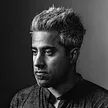
Today my longtime book editor, Jonathan Segal, turns 80. Or, as he would write in the margin, “eighty (spell out numbers up to 100).” I hope Jon lives long enough to stop being spelled out. Because I still need editing — and so does this world of ours.
Jon and I have worked on three books together now: Winners Take All, my third and our first together; The Persuaders next (Do I need a comma before “next,” Jon?); and Man in the Mirror, which is out in September.
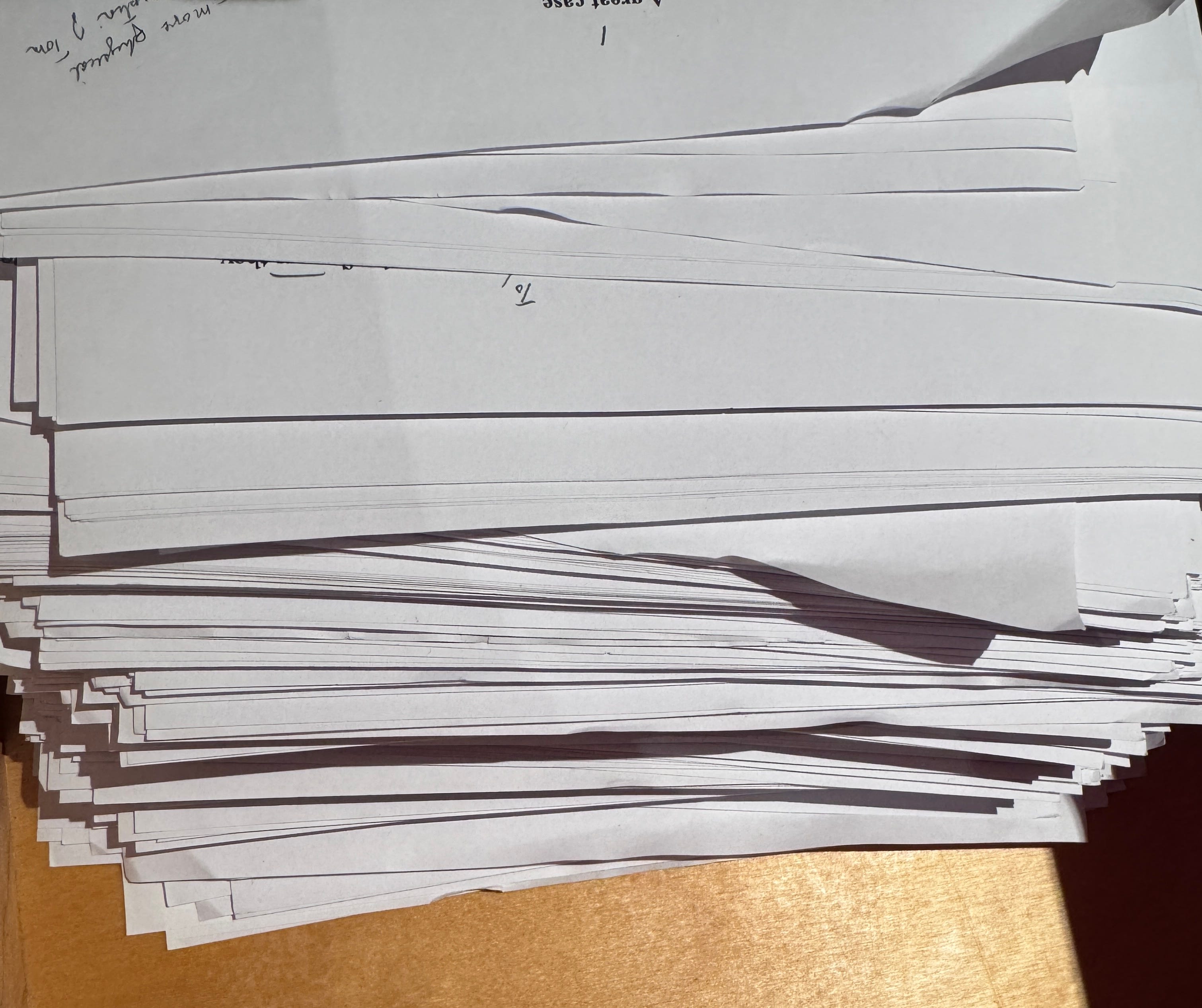
Lurking in this desk drawer beside me is a 750-page print-out I submitted of Man in the Mirror, which is about the case of Jordan Neely and Daniel Penny and their fatal encounter on a New York subway car, and all the ways in which the case illuminated a divided and troubled city and country. (Don’t worry: thanks to Jon, it shrank by half.)
Here is what I see in Jon’s edits on the first page alone: Minute attention to detail — capitalize the chapter title. Empathy for the eventual reader’s curiosity — “more physical description of Tom.” An awareness of the relationship one builds with a reader, a relationship that is not yet robust enough on page 1 to tolerate my usage of “dude” — “a little too informal for this opening.” A faith in the reader’s intelligence — don’t over-explain; eliminate the gilding of any lily. An empathy for the reader’s busyness — delete every word not needed.


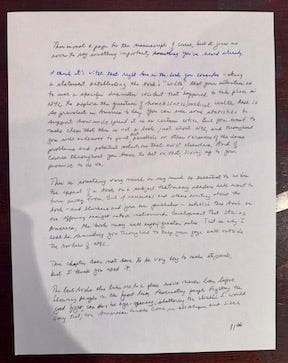
And then I come upon, a few pages later, a blank page that has been inserted, and on which Jon has handwritten a multi-paragraph note to me. It is about making sure that this book about one case in one city is also a book that speaks to people far beyond. It is about telling the small story so that it feels universal. Editors are required to catch grammar mistakes, but this kind of thing is extra credit. Only the great ones do this.
We met all the way back at the beginning for me, when I was working toward my first book, India Calling. I was living in India, working as a foreign correspondent for The International Herald Tribune and The New York Times, and I knew I wanted to write a book. But at the start, that was all I knew.
My agent at the time, Steve Wasserman, introduced me to Jon on one of my trips to New York. Steve explained that Jon had once been a New York Times guy himself. He had published lots of New York Times writers’ books. He understood newspaper people. But he had long since established himself as an editor at Knopf, the venerable publishing imprint that made the Gray Lady appear psychedelic by comparison. He could be a bridge for me, between the fast newspaper world and the slower book one.
I met Jon in Knopf’s offices in 2007. I remember marveling at all the books he had edited on the shelves. After the visit, I received a note from Knopf’s legendary publisher, Sonny Mehta, which told me that they were at least taking me seriously, maybe more seriously than I was taking myself:
I’m sorry I missed you the other day when you came in to see Jon Segal. I hope we get a chance to talk soon, either here or in India. Jon tells me you are mulling over the type of book you might write.
“The type of book you might write” — see, this is an under-appreciated part of the art of editing. A good editor is not just a commas-and-numerals cop, is not just a demolition crew for excess words. A truly good editor helps you find your book. And so Jon did. We went back and forth, back and forth, and he kept telling me that the stories were good, the ideas were good, but he found a certain emotional distance between me and the material. I didn’t know what he meant, because working for The New York Times had been my dream, and learning to create such emotional distance had made it come true. But, Jon told me, for a book, you have to stop being a reporter and become a “Writer.” He capitalized the “W.”
I tried to figure out what he meant for the longest time, tried to get more emotionally close to the material. Then one day I hastily wrote an essay for the Week in Review section of The Times. It was a rare first-person piece, about my generation of Indian-Americans, many of whom were suddenly finding themselves interested in moving, as I had years earlier, to their parents’ homeland:
Many of us, the stepchildren of India, felt its change of spirit, felt the gravitational force of condensed hope. And we came.
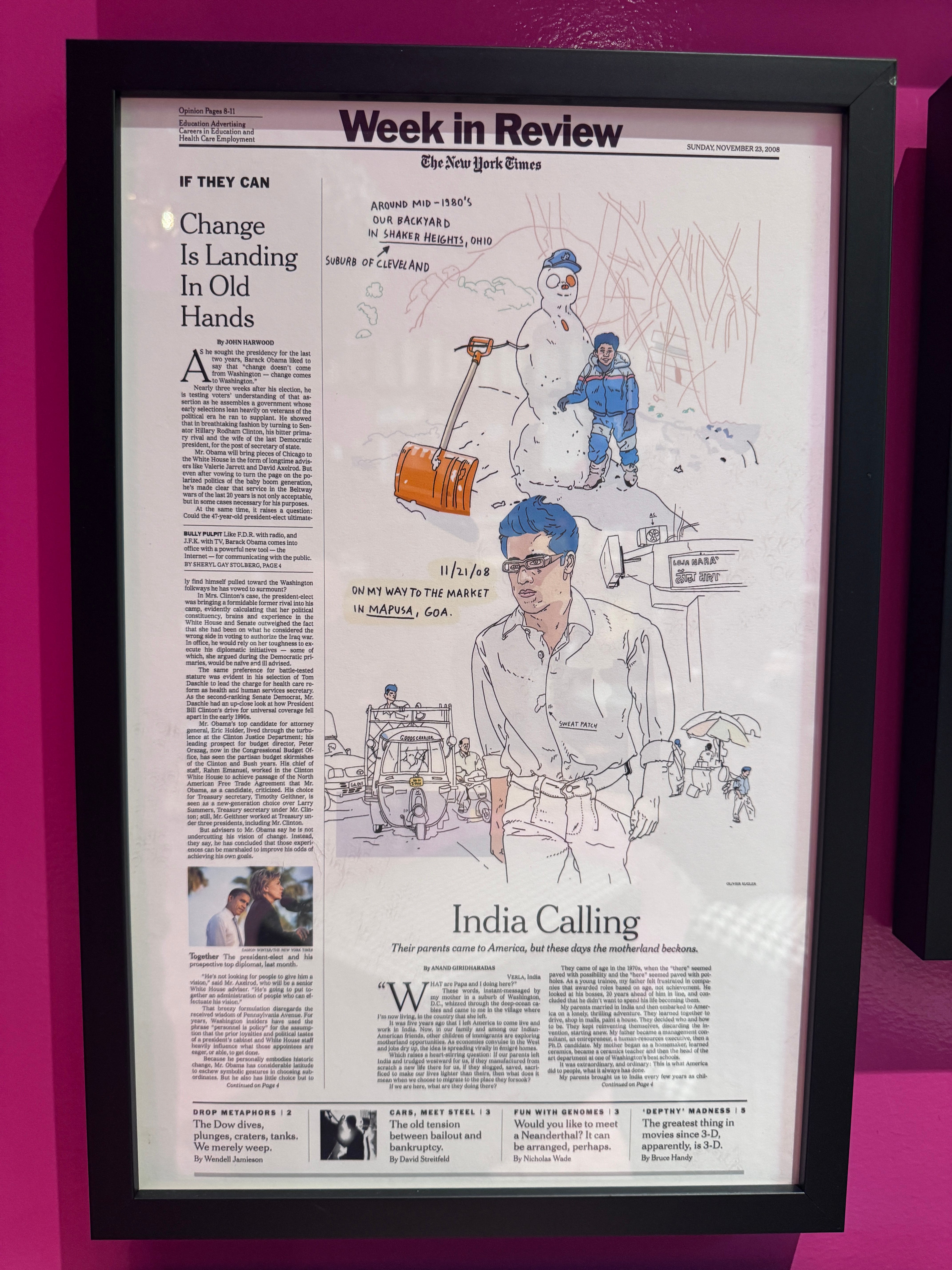
When Jon read that piece, he saw what he had felt to be missing. Do that, he told me. He explained that an average American reader might or might not care about the dramatic changes unfolding in India. One would hope they would, but one wasn’t able to count on it. What any human being would care about, he explained, was my India changing, my revisions of my inherited and secondhand and cursory impressions.
At first, it didn’t make sense to me. Why would someone care more about some twenty-something Indian-American’s evolving sense of India than of India’s changes themselves? But in time I understood: a whole country changing is too big for most minds; you can smuggle it in — indeed, 90 percent of the resulting book was about that — but it must be smuggled through what every person is wired to be interested in: the story of what happens to other people.
Jon worked with me on shaping that proposal for more than a year. Then, in the end, he didn’t bid on it. It just hadn’t gotten there. He took book-making too seriously to sign a book just because he had toiled on it.
And then, in the summer of 2015, I happened to give a speech in Aspen, Colorado, and the Times columnist David Brooks happened to be in the room, and he happened to write about it in his column the next day, and it happened to make a splash, because, apparently, you’re not supposed to tell billionaires they are the problem to their faces. And the thought of a book emerged, and Jon went for what became Winners Take All.
I reported it, I wrote it, I rewrote it, I revised it, I submitted it. And Jon, who had been so enthusiastic about the idea, was less than thrilled. He loved a lot of it, but a lot of it he didn’t. It was hard to take. He told me clearly: Don’t sit on the sidelines and throw rocks at this world. Go inside of it and show people grappling. I threw out half the book and found new characters and reported afresh and wrote and rewrote. When we finally got there, I thanked him for pushing me to write what I had, and he replied:
Thank you for the kind words. Rest assured that I am as hard on myself as I am on everyone else I work with because I think that the making of books is something of a sacred calling, though worshipped by a diminishing number.
We were at Jon’s favorite Italian joint in 2018 when we got word that Winners Take All had debuted on the Times bestseller list.
Though separated by a generation, Jon and I shared that sense of books as sacred. It took me a long time to realize that we also shared a dual orientation of taking the world very, very seriously when that was what was needed, and living in joke mode pretty much every other second of the day. It took me time to understand that he could be fierce and unswerving with the work, but that the relationship with the writer transcended the work. He could love you even when he hated your chapter.
Jon is tough, he is authoritative, he is protective of a calling he still finds to be sacred. But he makes all of his edits in pencil. And he always tells you it is your call in the end. Unlike at the newspaper, it’s your book. You own the book; you own how it’s seen. So he writes in pencil on a manuscript that has been printed out, in the year of our lord 2026, but he doesn’t insist on being the last word. He has made his living by revisions, and he knows that revising is not just a job but a way of life. Sometimes the editor revises you; sometimes you revise him.
Happy birthday, Jon — with everlasting gratitude for your vision and your revisions.
This just makes me happy. I appreciate that you acknowledged the greatness of the person who played a part in your success. Your humility (and humor) are a breath of fresh air!
Timely tribute to the unsung heroes of the written word: our editors.