


Last night we stopped by Spike Lee’s block party in Brooklyn to celebrate the Knicks. Over here, Bad Bunny played on speakers mounted on top of a car. Over there, people smoked and generously offered blunts. New York was even more in love with itself than usual. Game was being spit, and maybe a little more welcomed than before. A cultural practice more common in other parts of the country — saying hi to people simply because you are passing them — has set in. Everyone now seems a Knicks fan.


The sudden universality of Knicks fandom has old-timers tskingly gatekeeping. They prowled the photos of the celebrities at games and asked: When did she become a Knicks fan? There are sneers about “transplants” from other parts of the country becoming fans right as victory neared, seeming to resent that the newcomers have cut the line of patient, long-suffering true fans.
I will confess to being perhaps the most recent Knicks fan of all. I am so recent a Knicks fan that I was surprised to learn about the silent “K.” I am so recent a Knicks fan that I thought Timothée Chalamet was the point guard. And, to be clear, it’s not specific to the Knicks. Though I’ve lived in New York most of my adult life and both of my children were born in the city, my relationship to basketball was forever marred by being picked last on school teams. If this sport doesn’t want me, then I don’t want it!
But then this whole thing happened. On the night of the finals, I found myself in Puerto Rico of all places, in a sports bar that was split 80-20 in favor of the Knicks, and I had become so possessed by fandom that I was directing most of my cheers to this couple nearby that was loudly whistling for the Spurs, and I kept screaming at them to “Remember Game 4,” as though I were some kind of keeper of the scrolls. And then last night I was somehow in a blue-and-orange jersey I fished out of my closet, and my children had Knicks-coded glitter smeared on their faces, and my son even painted one arm blue and the other orange, which made him look less like a basketball fan than someone staging a covert military advance in an artificially colored jungle.
New York fans losing their minds at the sports bar in San Juan, Puerto Rico.
So where do we fit in this frenzied fandom, we the non-fan fans, the fannies-come-lately? Why are we so moved? What are we cheering for, those of us who think a “pick and roll” is a kind of sandwich, a “lay-up” is a short nap, and an “alley-oop” is a sex act more commonly undertaken in Europe?
Here is one theory. In cheering for New York’s Knicks, we were also cheering for the Knicks’ New York. Rooting for a team that staged jaw-dropping comebacks is also rooting for a city whose raison d’etre is comebacks — second chances in a new nation, reinventions of the self, overcomings of odds. In relishing a team whose superpower is instinctual mutual knowledge, who know each other like kin even though they are not, we saw a reflection of the chosen families so many of us forge in New York. And in celebrating a team built not on the superstar model but that of the orchestra, we were standing up for the power of what emerges spontaneously from diverse groups, no matter what the autocrats will tell you.
To cheer for the Knicks’ New York is to stand up not only for New York but for the city in general, the idea of the city, an idea under threat in Donald Trump’s America. Cities like this, we are told, are not meant to work. Too much ethnic mixing, too much freedom, too much chaos, too much disorder, too many immigrants, too many genders, too many people on the edge’s edge.
And you have to admit, if you want to be fairminded, that there is no reason this should work. Let’s have eight million people jammed together in the smallest space possible, and let’s deprive most of them of amenities that people elsewhere take for granted, and let’s make it so expensive that even rich people feel poor, and let’s make people work at their edge so that everyone else has to work at their edge to keep up — if someone pitched you this idea as on “Shark Tank,” you might tell them it was nice of them to come in, you’ll call if interested.
And yet it works. Oh, how it works. You don’t end up with a housing crisis if no one wants to live there, after all. People want in on this place they can’t possibly afford. They are willing to submit to a poverty they could avoid elsewhere — for what, exactly? The intangible magic of these eight million other people, this assemblage of all the dreams from all the places, the thrill of living surrounded by so much trying. There is something incandescent about living around so many people who didn’t take the advice to do the easier, safer, known thing, who said no to the family occupation, said no to Iowa, said no to conversion therapy, said no to accounting as a backup.
Cities like this are also supposed to not work because of all the difference. You’ve got every race under the sun here, every country of origin, every religion that thinks the people who do not subscribe to it are going to hell or at least out of their mind, you’ve got your capitalists in their fleece vests, you’ve got your socialist mayor, you’ve got roots of many generations and transplants, you’ve got people whose people in other places would kill each other if they met each other, but here they will split a cab.
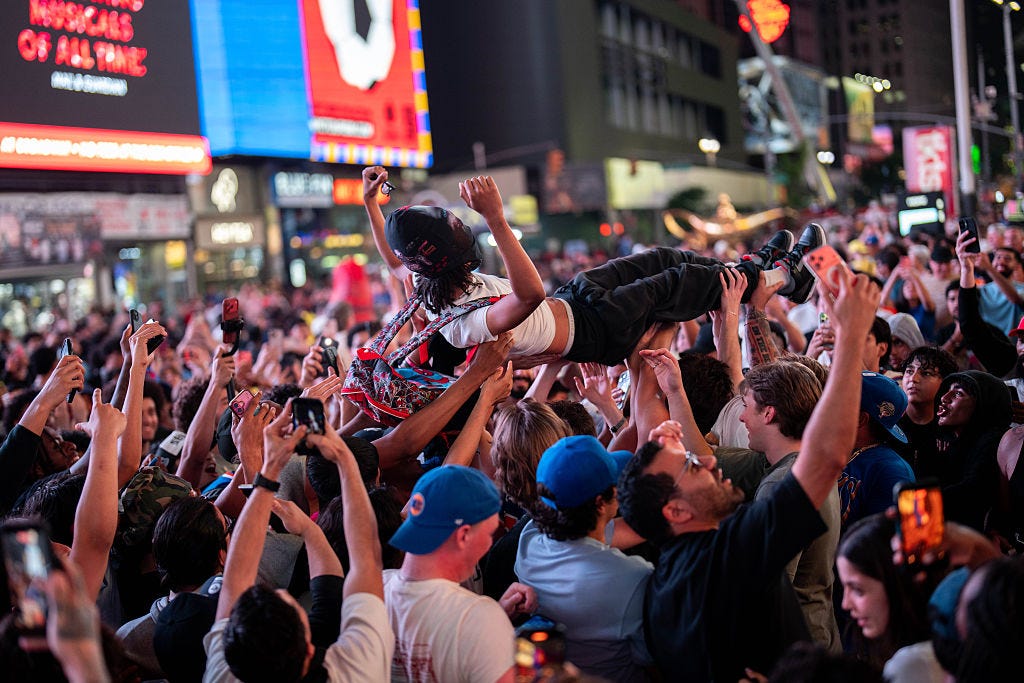
To scream and dance for the Knicks’ New York is to scream and dance for this, too — for the shouldn’t-work-but-does of it all. For the ennobling experience of sharing earth with those not your blood, for the faith in strangers that makes you choose them over your native village in Pakistan even before you purchase the flight ticket, for the knowledge that the helter-skelter, emergent brilliance of diverse people sharing space will always outshine and outlast those who declaim that they and only they can fix it.
Cities are facts. Countries are fictions. This I will defend to the death. I have walked the time-chewed ruins of Rome, the teeming riverbank of Istanbul, the shoulder-width lanes of Old Delhi. So many pretentious countries around each of them came and went. They were this empire, that empire, this totalism, that totalism, this national self-conception and that one. One day you’re the Roman Empire, overlording all. The next day, you’re a bunch of regions struggling to add up to something as big as mere Italy. Life comes at nation-states fast.
But cities endure. They endure because the people who are there are there for the other people, and this somehow lasts. They continue to congregate and pollinate and make shit and dance in the streets even as the countries around them cycle through follies and regimes and disastrous devaluations and ideological purges and pivots. Cities generally don’t declare thousand-year reiches or claim a century will be theirs. They don’t need to fake it till they make it. They know they will outlast so much of what surrounds them, because they have what nations can only envy: people who do not need a flag or a song or a recited pledge to feel they have need for each other.
But now New York has these Knicks. And so do I. And part of what we’re all cheering is the knowledge that what is happening here, what always has, will outlast the madness, the cruelty, the lack of imagination of those who fear the magic.
[UPDATE: An hour after posting this, I ran into Spike Lee on the street. We fist-bumped, the oldest fan and the newest fan united in joy.]
This is a beautiful essay. Perfectly encapsulates what it is to live here in NYC.
Absolutely beautiful. To me, New York has always been the home for anyone who doesn’t have a home elsewhere. Now more needed than ever