


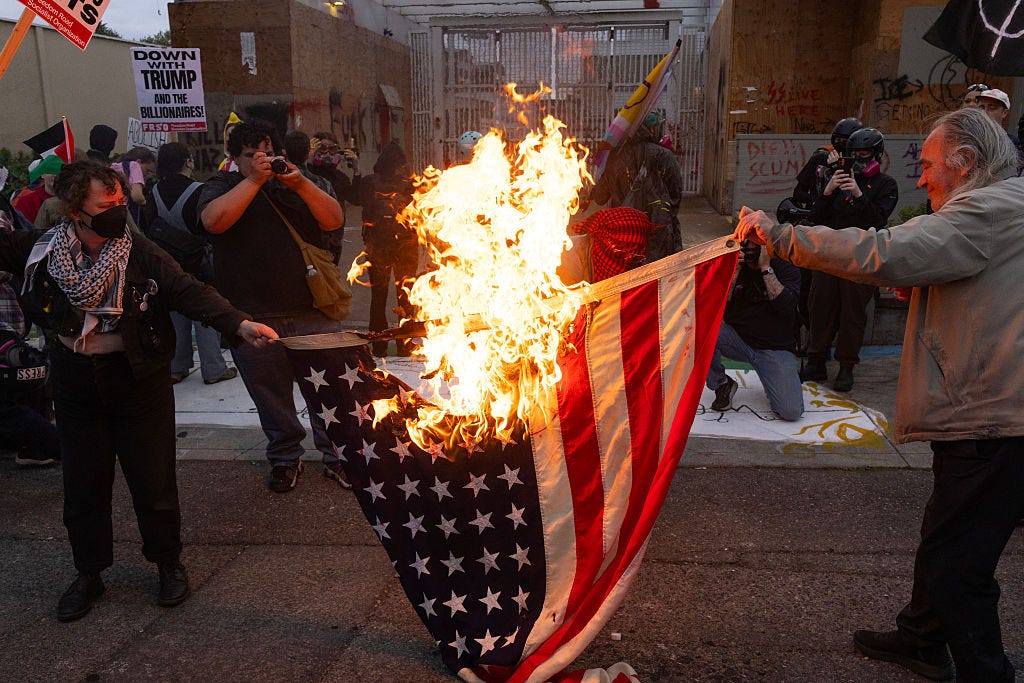
When you love someone and they act out in rage, you may summon the curiosity to wonder what is really going on beneath the behavior. This turns out to be harder to do with those you merely share a country with.
The country barreling toward another election in two weeks is full of furies. Furies of every kind — furies for which you will have empathy, furies for which you will have contempt. But furies all the same: over the price of gas, the price of war, the threat of extinction, the threat of work disappearing, the stench of corruption, the persistence of seemingly solvable problems not being solved, the indifference of anyone who can help, the indifference to suffering and genocide, the condescension from the citadels, the inaccessibility of the rudiments of a good life, the lectures about how one should be building that kind of life anyway, the hoarding of wealth, the tolerance of disorder, the arsons set by those in firefighter costumes, the seeming breakdown of cause and effect itself, the feeling that doing the right thing does you no better than not doing it, the sense of not mattering, of being unrecognized, of feeling mocked by the future.
Here and around the world, governments — entire systems — behave as if running a democracy version of the Stanford prison experiment: How far can you push the public with the performance of indifference, how much of a crisis of respect can you let fester, before everything begins to dissolve?
Everywhere the triggers are different, the slogans different, the characters different. So much political writing naturally is about these specific issues and personalities and demands. What goes missing from this picture is the emotional core of the furies. If we saw one person flailing like this, we should want to know what they were going through. When it’s all of us, the mode of analysis changes. The inner life is forgotten.
Instead, we fixate on each phenotype of fury. We register approval or disapproval. We pick sides in the embittered heteropessimistic dating wars on social media instead of stepping back to see how utterly painful it must be, across the board, that so many young people who want to find love cannot find it and despair of ever finding it and have begun to wonder what all of this living is really for. We validate or condemn those who fear a chaotic border and the nation’s changing complexion — or those who fear “transplants” and gentrifying neighborhoods and the changing hue of their cities — or those terrified by the masked men — and we fail to detect that, beneath the particular complaints, they are saying the same thing: that they feel unmoored, de-centered, not quite sure who they will be in the times that are coming. We align ourselves either with those giving themselves over to A.I. with eighteen-hour “grindset” workdays or with those who are fighting data centers in their communities, unable to see the shared panic under both courses, the fear that being a normal person living a normal life will be untenable in the times ahead, a fate akin to a living death.
So much of our politics thus functions as a competition between rival expressions of the same underlying alienation from progress. Fixated on the symptoms, which differ from person to person, we ignore the disease, which we share. The anxiety of parents about how to raise children in this turbulence, how to educate them when everything is up in the air. The pity and annoyance of seeing our cities encamped with suffering no one fixes. The dejection of seeing leader after leader promise to care, promise to end things, restore things, and they just never do. The fatalism of knowing that things are not fair and don’t seem to be getting fairer. The bitterness of sensing that people over whom you have no control are making decisions about whether you can thrive. The pessimism of seeing even the most heinous crimes — against humanity, against children — go unpunished because of who the violating tanks or penises belong to.
But we keep not seeing things at this level. We keep not seeing each other on this level. We keep getting stuck on whether I like the form your fury happens to be taking today, on whether this leader or that leader is more dangerous, on which of us is the genuine, bona fide kind of citizen and which of us is the threat, the enemy, the Other.
And the dreams you hear all around you in times like these are dreams of elimination. People are too polite to put it in those terms, but it’s what they’re saying. The dream is for a society rid of the people whose expressions of fury they find distasteful. This is not a fantasy confined to one side or the other. Listen deeply to our political discourse and notice how much of it is inflected by the feeling that everything would be better if certain of our compatriots were not to exist.
Who knows what these elections will bring. One team beating another, some short-term glory, some vindications and autopsies. Maybe even some introspection. But these are not the kinds of things that will deliver us to some different kind of time.
What will is the return to each other and a renewal of interest in what each of us may be trying to say when we scream. Anger, a wise woman once told me, is what pain looks like in public. The work ahead, the real work, is to find the threads in the pain.
As a retired psychotherapist, I see the perspective you are encouraging as much the same as any good therapist would suggest, and that is: not to focus only on the presenting problem, but on the dynamics that undergird the problem in a person's life or in their relationships. It's only by identifying the underlying dynamics (i.e
the unhealed wounds, the disappointments, the dysfunctional beliefs - basically the underlying commonalities I that you speak of) that progress towards a lasting solution can be made.
The Principal at a school sets the tone. So does the President of a country.