


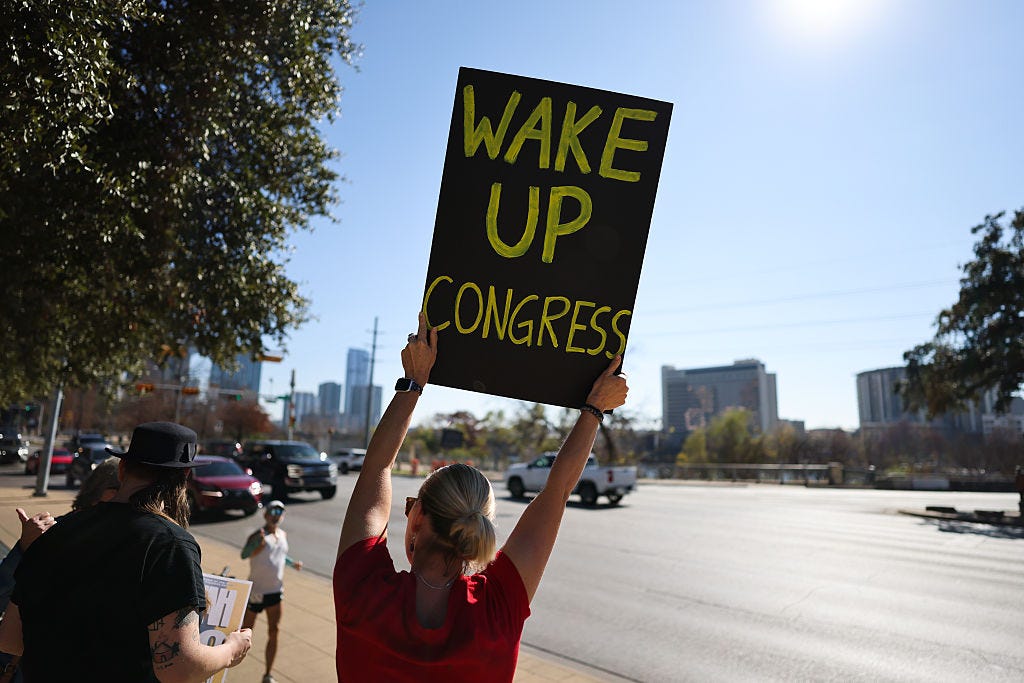
In the midst of the longest government shutdown in American history, lots of Americans are wondering why Congress doesn’t work anymore.
That question isn’t new. For decades — long before the power grab by the executive branch under Donald Trump relegated the House of Representatives to a rubber stamp — new members have come in promising to get Congress legislating again. Yet the problem has gotten worse.
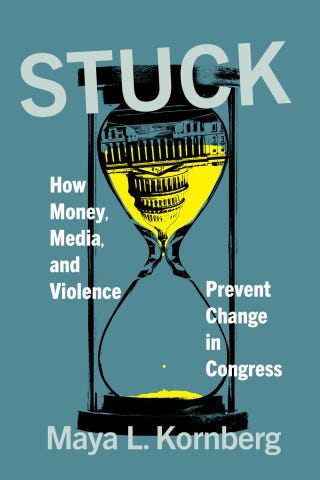
In her new book, Stuck: How Money, Media, and Violence Prevent Change in Congress, congressional scholar and author Maya Kornberg looks to explain why. She examines three incoming classes of reformers: the 1974 “Watergate Babies” elected after Richard Nixon left office; the Republican revolutionaries of 1994 who enacted Newt Gingrich’s Contract with America; and the 2018 Democratic class elected in the backlash to Donald Trump’s first term. In all three cases, Kornberg finds a cautionary tale of how the struggle to build and hold power in a political world shaped by money and media coverage has further immobilized Congress — and also finds clues for how the House might take back its power, and lead the way out of our current crisis.
We talked to Kornberg about where things went wrong, how even the best-intentioned reformers have ended up exacerbating the problems they set out to solve, why social media has made matters so much worse, and what solutions might look like — if voters and the next incoming class of House freshmen decide governing is worth doing.
The Ink is powered by readers, not billionaires. Help us stand up for independent media that isn’t afraid to tell the truth by joining us today.

The House of Representatives has more or less given up governing, beyond providing a backstop for the executive branch. But this is not new. You’ve written about past cycles the House has gone through: Congress gets stuck, people come in, sweep out the incumbents, decide they’re going to change the institution, and often make things worse. Is the current crisis more of the same, or are we seeing something new?
We have a perfect storm right now in terms of disempowering Congress.
You have Supreme Court decisions — in 1976, Buckley v. Vallejo, in 2010, Citizens United — allowing money to flood campaigns and remaking the way members think about seeking power within the chamber. And you have what one journalist called Congress self-lobotomizing in the 1990s. One of the key periods I talk about in the book is the Republican Revolution. Newt Gingrich comes in and defunds entire congressional support agencies, like the Office of Technology Assessment, which used to help Congress understand science. He cuts staff of key agencies, like the Congressional Research Service, by about a third, cuts the committee system, and does so many other things.
He was sort of a precursor to DOGE.
Yeah, definitely in terms of the spirit of it, the dynamic of making government smaller. You have a Congress that is just not investing in itself, in which Congress isn’t figuring out how to retool its structures. I mean, it hasn’t redrawn its committee jurisdiction since the 70s, before the internet existed, so it’s just completely ill-equipped now to deal with such tremendous problems, as executive abuse of power and the complexity of policy issues we face.