


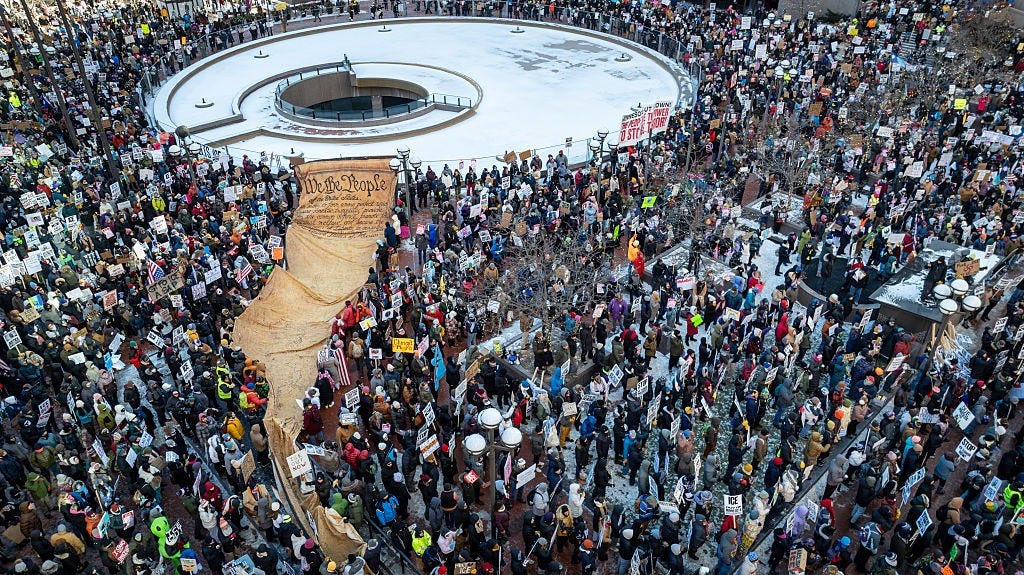
Who’s allowed to protest? Who is allowed to speak on behalf of the powerless?
We talked last week with Bruce Robbins, the Old Dominion Foundation Professor in the Humanities in the Department of English and Comparative Literature at Columbia University, and the author of a new book that takes on those questions and the motives of those who’ve looked to deny protesters a voice, Who’s Allowed to Protest?

In the new book, Robbins, who has long been concerned with the limits of political communication, examines how anti-elite arguments — charges that those pressing for change are doing so out of a desire for status — have been employed to collapse the distinction between academic experts and cultural leaders and the truly powerful, silence political protest, mislead people about who’s actually in charge, and narrow the range of political possibilities.
We talked about how charges of privilege have been used to defang critics of power since the 19th century, how the crackdown on student protesters against the war in Gaza foreshadowed the second Trump administration’s mass deportation campaign, the possibilities for reestablishing connections between student activists and organized labor, the way the Jeffrey Epstein files have revealed the distinctions between cultural “elites” and their far more powerful moneyed counterparts, what the mass mobilization of communities in Minneapolis against ICE means for the future of political organizing, and more.
The Ink is powered by readers, not billionaires. Help us stand up for independent media that isn’t afraid to tell the truth by joining us today.
In the DNC’s autopsy of the 2024 election, it emerged that the Democrats might have lost at least in part because of Harris’s failure to break with the consensus on Gaza.
The students were right; we’ve seen this with the anti-war movement and the anti-apartheid movement. And in light of how little support there is now for the attacks on Iran, the truth seems to be that people don’t want this kind of thing. Can you see this having the kind of long-term impact that, say, Occupy did?
I’ve been thinking from early on that, because the violence in Gaza came through kind of uncurated, unmediated, people were getting it over social media, and it really did speak for itself. It’s gonna have a long-term moral effect on that generation. And as they get older and more involved in the electoral process, we’re gonna see some consequences of that.
The political scientists are probably trying to measure this right now. I’m just speculating. But my sense of it is that even people who were not in encampments, who were maybe not marching anywhere, were not protesting. They just very quietly said, man, this should not be happening.
Meanwhile, the actual ruling class was continuing to denounce, in very familiar terms, the student protesters against the Gaza war, in the same breath, as elites who are speaking out of turn.
This starts for me at Columbia, in an elite institution, and in defense of my workplace. I was watching this and hearing some really loathsome things said about these basically being spoiled brats at elite institutions. And ordinary people really wouldn’t pay any attention to what they’re saying.
And that pushed some buttons for me, which are probably, in part, generational, because stuff like that got said about the student movement when I was young. We are bombing the shit out of Vietnamese civilians, and you’re telling me, you know, that it’s all about our Oedipal stuff with our parents.