


When Donald Trump spoke with The New York Times this past week, the president made clear that laws — domestic or international — don’t apply to him. When asked what constraints him to exercising his power around the globe, he responded: “My own morality. My own mind. It’s the only thing that can stop me.”
In 1776, Thomas Paine wrote that the law was the “King of America.” Trump has something very different in mind: the very kind of kingship Paine rejected 250 years ago.
During the first Trump administration, even those who had an expansive view of the executive, and were willing to cross the line for the president recognized some limits on his power. Their behind-the-scenes stories are told in the January Ink Book Club pick, Injustice: How Politics and Fear Vanquished America’s Justice Department, by Pulitzer Prize-winning journalists Carol Leonnig and Aaron C. Davis. But even the best-intentioned of those officials paved the way for what was to come.
As we discussed earlier this week, former Attorney General Bill Barr set the trap that defanged Special Counsel Robert S. Mueller’s findings, ultimately undercutting the investigation into the Trump campaign’s Russia ties. He also withdrew the case against Michael Flynn, even though Flynn had pleaded guilty to lying to the FBI in 2017.
A few days after the Flynn case was withdrawn, about two thousand alumni of the DOJ together published a public letter calling for Barr’s resignation, accusing the AG of assaulting the rule of law. They collectively wrote that “Our democracy depends on a Department of Justice that acts as an independent arbiter of equal justice, not as an arm of the president’s political apparatus.” In a subsequent interview, Barr was asked how his decision would be viewed by historians. “History is written by the winners,” he responded, laughing. “So it largely depends on who’s writing the history.”

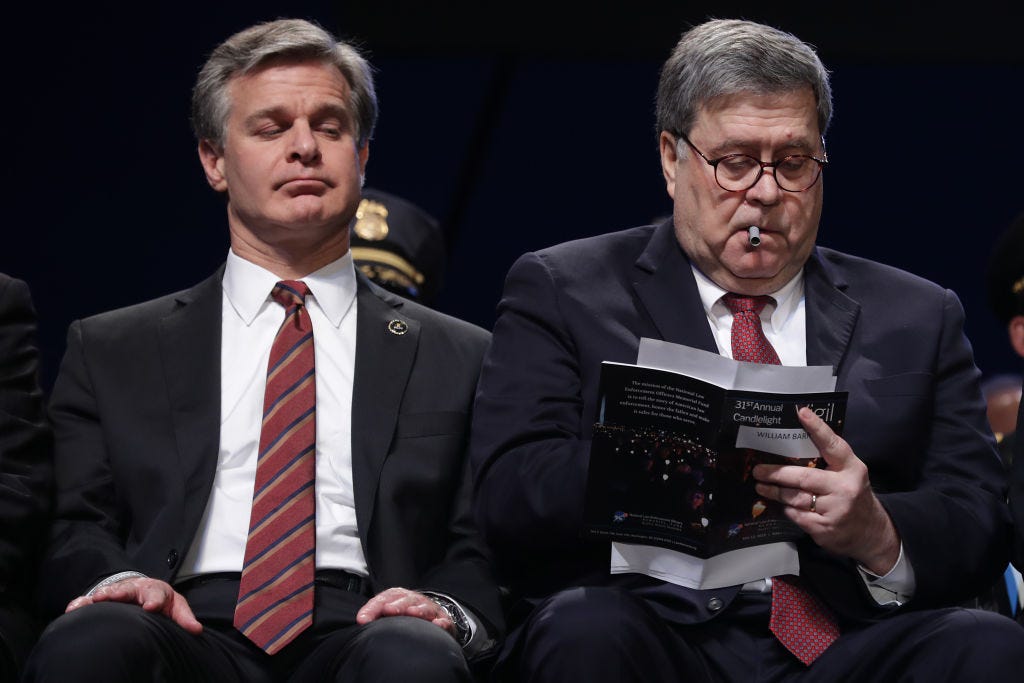
But, the Injustice authors write: “For all of Barr’s efforts to shape prosecutorial decisions to Trump’s liking, there was seemingly no end to the president’s displeasure with the department, especially its investigative arm.” Trump went on to target FBI Director Christopher Wray; when Barr found out that Trump planned to fire Wray and install Kash Patel in the deputy director role, Barr threatened to resign. According to the authors, Barr said that could only happen “Over my dead body.”
Despite his earlier obeisance, Barr went on to publicly disagree with Trump on multiple issues: Barr publicly disputed the president’s claims of election fraud, announcing that the DOJ had found no such violations in their investigation; Barr adhered to DOJ protocol by not publicly disclosing during the 2020 campaign that Hunter Biden was under investigation by the DOJ — Barr’s silence on the case infuriated Trump. Later, Barr began to speak openly about his increasing frustration with Trump’s unrestrained commentary and social posts about ongoing investigations, which, Barr felt, made it “impossible” to do his job.
But at that point, Barr was not working for a president who had asserted something close to the divine right of kings, or had launched an invasion without informing Congress, or had kidnapped the leader of another nation, or deployed military force to occupy cities and states led by political opponents.
Trump has clearly determined not to repeat the mistake he made in his first Administration, during which he appointed some officials who had the appropriate expertise for their roles and whose loyalty was to the rule of law–they would put country first. This time around, though, his only litmus test has been blind loyalty to him, and purging the FBI and the larger Justice Department of senior personnel who would proceed without fear or favor. We are now in uncharted waters.
On Wednesday, January 21, at 12:30 p.m. Eastern, The Ink Book Club will meet again with Injustice authors Carol Leonnig and Aaron C. David. We hope you’ll join us. Below, you’ll find some questions to consider in advance of our next meeting, and as you continue to read the book.
The Ink Book Club is open to all paid subscribers to The Ink. If you haven’t yet become part of our community, join today. And if you’re already a member, consider giving a gift or group subscription.