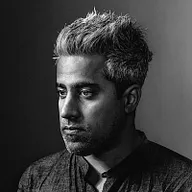



George Saunders’s work has provided his readers with immense pleasure over the years — as well as prompting any number of deep dives into the philosophical and spiritual realms — and his latest novel, Vigil, is both a pleasure and a provocation. Is there such a thing as salvation, and if so, does it come through an individual’s alignment with truth? Does free will exist, or are we pre-programmed to turn out the way we do, and to act the way we act?

When we meet with Saunders later today — and what a privilege that we get to do so — we’ll want to ask him how his thinking on these topics evolved in the writing of the novel, and where he came out at the end. We’ll also want to talk more about how he’s seen capitalism evolve in his lifetime. In a recent conversation with Ezra Klein, he remarked that he feels we are “increasingly handing over everything to sustenance…as corporations become so powerful there’s this push to give up more of one’s private space, one’s peace of mind, in order to live within the system.” How does Vigil fit into that worldview?
And of course, we’ll want to get into his process. How do his characters come to him? If, say, a novel like Vigil took him three years to write, how many drafts does he go through? What is his revision process? And, with K.J. Boone, for example, was there a real-life corollary he used in creating him, or an amalgam?
Saunders is one of our best living short story writers, whose first published collection was released in 1996 — CivilWarLand in Bad Decline, and was a finalist for the PEN/Hemingway Award for best debut fiction. His 2013 collection, Tenth of December, was a National Book Award finalist, and in 2017, he published his first novel, Lincoln in the Bardo, which won the Booker Prize. And if you haven’t already read his sublime homage to the Russian short story — A Swim in the Pond in the Rain — you’re in for a treat. He writes of the seven stories he highlights in that volume: “The resistance in the stories is quiet, at a slant, and comes from perhaps the most radical idea of all: that every human being is worthy of attention, and that the origins of every good and evil capability of the universe may be found by observing a single, even very humble, person and the turning of his or her mind.”
While the characters in Vigil perhaps cannot be described as “humble” — two spirit guides and an oil tycoon, after all — Saunders does usher us into their heads, where we try to puzzle out what makes them tick and what they signify for the writer, and for us, the reader.
We hope you’ll join us today at 1:30 p.m. Eastern for our conversation with George Saunders. The Ink Book Club is open to all paid subscribers to The Ink, so if you haven’t yet become part of our community, join today. And if you’re already a member, consider giving a gift or group subscription.