


Today, Wednesday, January 7, at 12:30 p.m. Eastern, join The Ink Book Club when we speak live with Pulitzer Prize-winning journalists Carol Leonnig and Aaron C. Davis about their new book, Injustice: How Politics and Fear Vanquished America’s Justice Department.
Watch on desktop at The Ink or join us from a phone or tablet with the Substack app. The Book Club is open to all supporting subscribers of The Ink, so join us now to take part!
Yesterday marked the fifth anniversary of the January 6th insurrection. While many of us mourned, some celebrated. The perpetrators of the event have been pardoned and even praised by the man who orchestrated it; he has once again become our president; and the White House has fabricated a new story to explain it all away.
How did this happen? Why didn’t anyone stop it? And how did what happened change American justice? Let’s make sense of the first part of this three-act tragedy.
One inescapable takeaway from this month’s Ink Book Club pick, Injustice: How Politics and Fear Vanquished America’s Justice Department, by Carol Leonnig and Aaron C. Davis, is that Trump and his cronies are adept at playing people for fools, especially those who believe in following the rules.
An exemplar of this brand of hardball, Leonnig and Davis write in the first part of Injustice was Bill Barr, who became Trump’s Attorney General in February of 2019, after Jeff Sessions was humiliated and forced out of the role for recusing himself from the Russia investigation.

Barr (who, by the way, authored a 1989 opinion backing the removal of Panamanian leader Manuel Noriega that’s behind the Trump administration’s defense of its invasion of Venezuela this week) had long believed that the Constitution grants the president nearly unlimited powers, including the legal ability to take many actions without Congress’s approval.
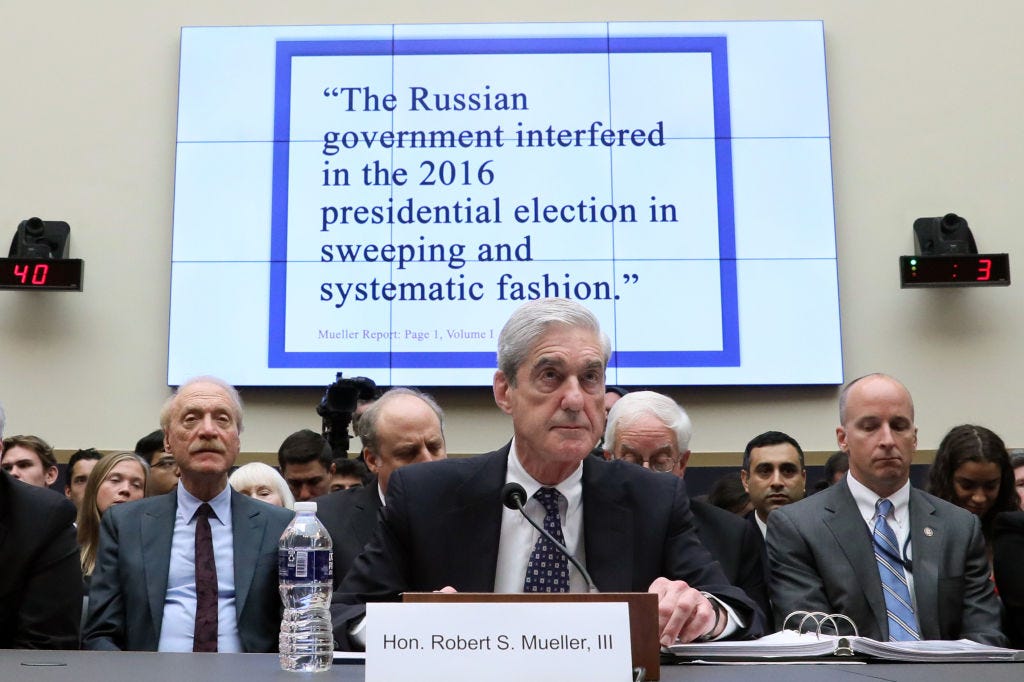
In an unsolicited memo to the DOJ in the summer of 2018, the Leonnig and Davis write, Barr claimed it was “legally impossible” for the special counsel investigating Trump to find him guilty of obstruction of justice because the president “was the very instrument of justice.” When Barr was sworn in as AG the following year, he immediately asked to be brought up to speed on the progress of the obstruction and election interference charges being explored by former FBI Director Robert Mueller and his team.

In a face-to-face meeting with Barr, Leonnig and Davis report, Mueller didn’t appear to be himself — his hands shook, he seemed uncertain, and soon turned the meeting over to one of his colleagues. Sources told them that Mueller no longer appeared to be “the commanding and razor-sharp G-man from only a few years back.” Mueller told Barr that because department policy prohibited indicting a sitting president, he and his senior advisers had decided they would not publicly state whether Trump had committed a crime. As the authors write, Mueller “had decided not to decide.” They would release a report along with an executive summary.
Barr saw an opening: once the report was submitted to his office, he sat on it until he could deliver his own interpretation of the report to Congress, undercutting much of the compelling evidence of wrongdoing Mueller’s team had undovered over the course of their investigation, Barr instead offered his own misleading summary: that no one associated with Trump had conspired with Russia. Since the special counsel had opted “not to make a prosecutorial judgment on whether Trump had obstructed justice,” Barr made one for them: He decided there wasn’t sufficient evidence to charge Trump.
Leonnig and Davis write that “Mueller’s stubborn belief in the institution had been honorable but naive.” He’d proceeded out of extreme caution in an effort to preserve the integrity of the DOJ and undercut any claims that politics had colored the investigation. “Old school to the end,” the authors write, Mueller played into a trap set on the board by the leaders of his own Justice Department.”
Injustice contextualizes all we are witnessing today, revealing how that moment laid the groundwork for many of the outrages being perpetrated by the second Trump administration, and how it was often well-intentioned defenders of the rule of law who were blinded by their belief that the institution they had devoted their lives to would hold the line, and by their mistaken conclusion that Trump would never win a second term.
The Ink Book Club is open to all paid subscribers to The Ink. If you haven’t yet become part of our community, join today. And if you’re already a member, consider giving a gift or group subscription.