


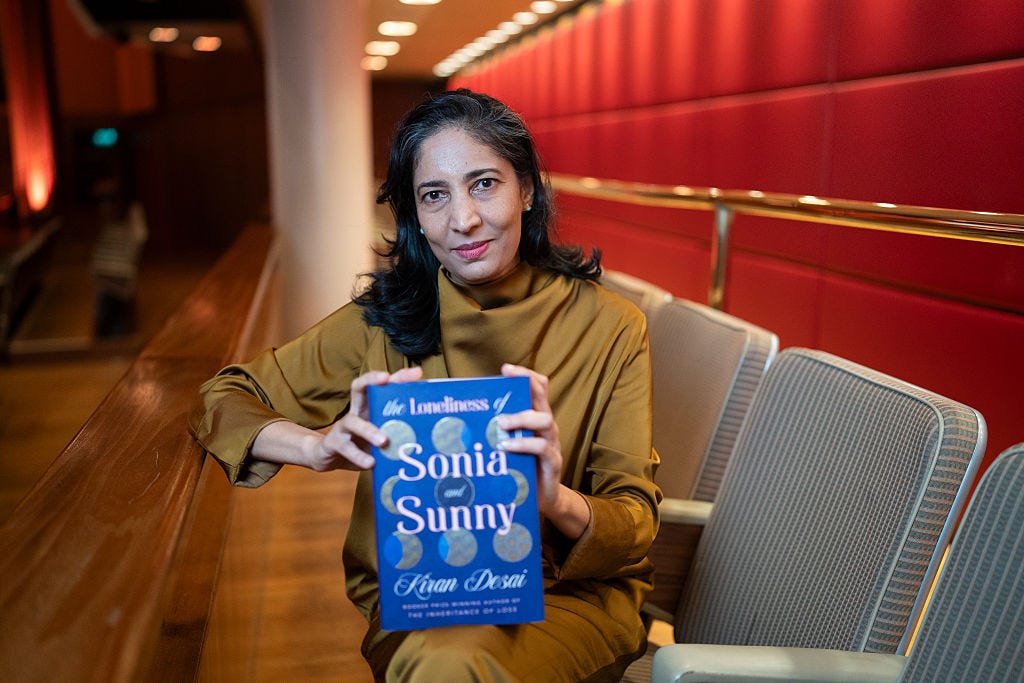
The Ink Book Club is kicking off the holiday season with a wonderful novel that has been named a best book of 2025 by The New Yorker, The New York Times, the Washington Post, and NPR, among many others. It was a finalist for both the Booker and the Kirkus Prizes.
Kiran Desai’s The Loneliness of Sonia and Sunny is epic yet intimate, with a love story for the ages at its center, and yet it also exquisitely interrogates many of our time’s most salient issues. In her review, New York Times critic Alexandra Jacobs remarked that the book is “not so much a novel as a marvel.” The Kite Runner author, Khaled Hosseini called it “An unmitigated joy to read.” Neither comment is an exaggeration — I loved this book so much that I cried while reading the last fifty or so pages, knowing I was close to the end. And unlike many contemporary novels, the ending truly satisfies. It’s cinematic.
Desai won the 2006 Booker Prize for her second novel, The Inheritance of Loss, in which an embittered judge’s desire to retire so he can sink further into a life of isolation in the Himalayas is thwarted when his orphaned granddaughter shows up on his doorstep. It’s filled with lines like this one, which I can still recall underlining when I first read it: “The solitude became a habit, the habit became the man, and it crushed him into a shadow.”

As her previous works have done, The Loneliness of Sonia and Sunny seamlessly probes the effects of globalization, the legacy of colonialism and partition, immigration, and the strictures of family on the formation of identity, without any trace of didacticism. Desai herself was born in India, moved to London as a teenager, and now lives in New York City, so she knows well the experience of the immigrant, another theme the novel wrestles with.
The romance that is at its heart contains all the elements of an old-fashioned love story, and all the complexity of modern life. Desai has said that three of her literary influences were Leo Tolstoy’s Anna Karenina, Milan Kundera’s The Unbearable Lightness of Being, and Snow Country, by Yasunari Kawabata. (I haven’t read that last one, but I’ve since ordered it from my local bookstore.) What she particularly wanted to explore here, she says, is that “romantic ties once dictated by social class, religion, and community have become more a matter of chance.” In the case of Sonia and Sunny, yes, there’s a “meet cute,” but there is also a family involvement that complicates everything and yet makes their relationship seem fated to be.
Desai writes sumptuous sentences that elevate even mundane objects: ”Two squat phones rang out like toads in a swamp,” was one of thousands that delighted me. Her storylines and her authorial perspective are always guided by a kind of moral intelligence and clarity of the sort that has led many researchers to conclude that reading fiction nurtures empathy. And at 670 pages, The Loneliness of Sonia and Sunny serves not only as an antidote to the short attention span, but to loneliness itself, as the best novels do.
In our Book Club live conversation with Kiran Desai this Wednesday, December 10, at 12:30 p.m. Eastern, we’ll discuss why twenty years have elapsed between novels, and what she means by observations like this one she has made about her process: “Artistic loneliness can be exquisite.” Please join us for that talk! And we hope you’re enjoying the start of the holiday season.
In the meantime, we invite you to share your questions for Kiran Desai and about The Loneliness of Sonia and Sunny in the comments below. To get started, we leave you with some questions of our own, below.