

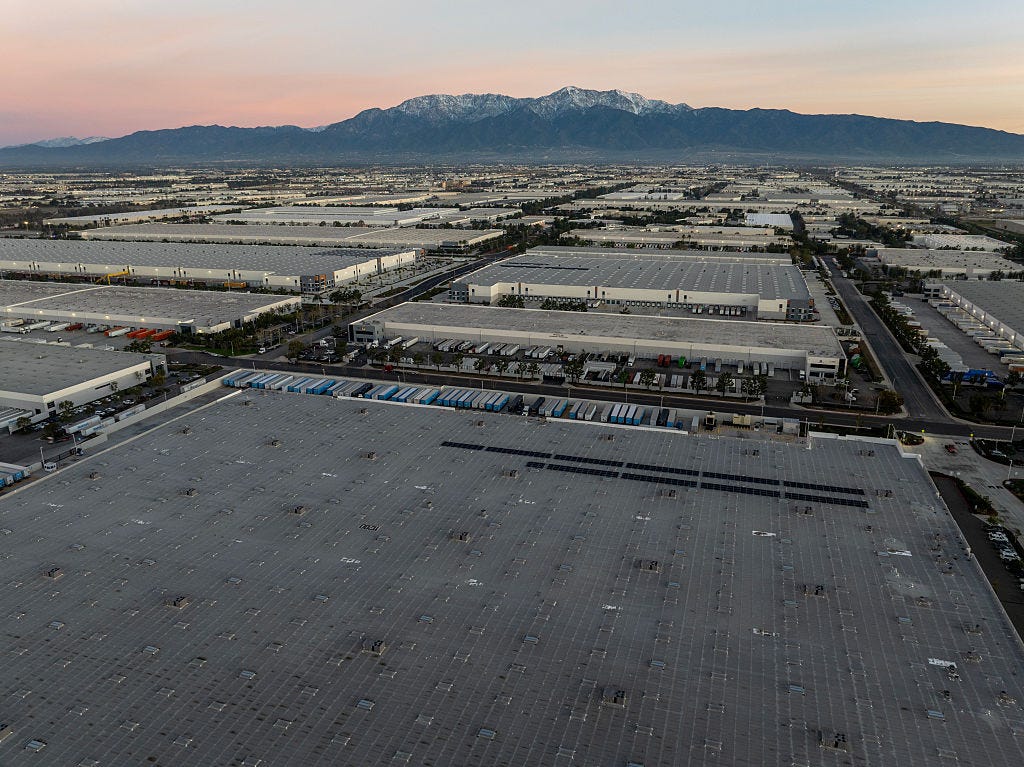
Last month, the Department of Homeland Security abandoned its plans to purchase a warehouse in Lebanon, Tennessee, part of the Trump administration’s $45 billion spending spree intended to build a network of immigration detention centers stretching across the United States — a sprawling penal colony to rival the Soviet gulag.
But long-simmering public resentment against this new gulag has begun to boil over, as communities — where warehouses had already driven down wages, killed off small businesses and jobs, and worsened pollution — grapple with the idea of having a concentration camp next door. Across the country, detention center projects — like those in Surprise, Arizona, and Salt Lake City, Utah — have met with fierce pushback.
That’s what halted the Tennessee project. As local resident Chris McFarland told the Wilson County Commission:
Let me be perfectly crystal clear: These camps will not be tolerated at all… This ground you stand on is one of the highest concentrations of combat veterans in this country, people who have already faced tyranny abroad, people who recognize state cruelty because we’ve seen it up close and stopped it. I’m one of them.
To get a better understanding of what’s being built in America, what kind of country we’re building in the process, and why and how people are making clear thay won’t stand for it, we talked to journalist and author Andrea Pitzer, whose book One Long Night: A Global History of Concentration Camps explores what makes a concentration camp — and what makes a concentration camp society.

The Ink is powered by readers, not billionaires. Help us stand up for independent media that isn’t afraid to tell the truth by joining us today.
A system of detention camps is taking shape across the U.S., and there’s fear, or a willful blindness, or just an unwillingness to look at these and call them what they are — concentration camps. And understandably, that’s tied up with how we see the Holocaust, as when, back during the first Trump administration, Rep. Alexandria Ocasio-Cortez called the border detention centers concentration camps — there was a big fracas in the media, calling her out and accusing her of missing the historical specificity of the Nazi camps.
Why is the idea of the concentration camp one of these topics that we can’t really seem to talk about, even though it’s been with us so long?
One reason is that the Holocaust was such a singular historical event in which almost every modern sort of manufacturing and scientific tactic was tapped into to actually eradicate a people, and not just the Jewish people, although certainly that’s where the enormous brunt of it was borne, but also the Roma and Sinti people.
Then to see a modern country even interfere with its own war aims to carry this out, which is also a parallel we might look at today. It was a singular moment, and the death toll was a singular thing. There is a reverence toward that, there is a respect toward that.
And in my book, I say that’s a tremendous upside that we keep that in mind, and that we remember what happened. To survive, it’s like an evolutionary impulse, in terms of the mind. But, after the magnitude of the extermination centers, and Auschwitz as the avatar of those, nothing else qualified as a concentration camp for people. That became the ur-camp idea, and the fact that that took decades to emerge, and almost a decade in Nazi Germany itself to emerge, was lost, and so this history that I went trolling through became very much, how did we get to that?
What you’ve pointed to clearly is that a concentration camp is not necessarily a death camp, though it’s part of the same system.
And it can lead to that, as we have seen, but it does not need to be an extermination center to be a really harmful concentration camp.
Every culture, every society has its abysses, its fissure lines along which it can be broken. You don’t get to be a concentration camp society without there being really serious problems inside that society. And the cultural history and events that lend themselves to letting those camps rise also lend themselves — and I’ve seen this again and again — they also lend themselves to saying, well, these are not concentration camps. Our camps aren’t like those prior camps. This is an actual necessity in our country or in our region at this time, and these are bad people who are a real threat to us as a people or as a nation. Inside these societies that do it, it never feels the same. It never feels like that rhetoric should apply.
These things are presented as part of normal life in a modern society. That there’s something terrible going on that needs to be dealt with; we need to be kept safe.