

In our household, the beautiful chaos continues. Priya is somewhere between Florida and California. Last night I abandoned my kids to mow down some sushi on their own because I had to speak to a university class taught by my first mentor in journalism, Jill Abramson. Today, another frantic day of podcasts and signing several hundred books, many of them bound for you all. When I apologized to my kids for how scattered I’ve been, my son said, “It’s OK, it’s for a good cause.” I love them.
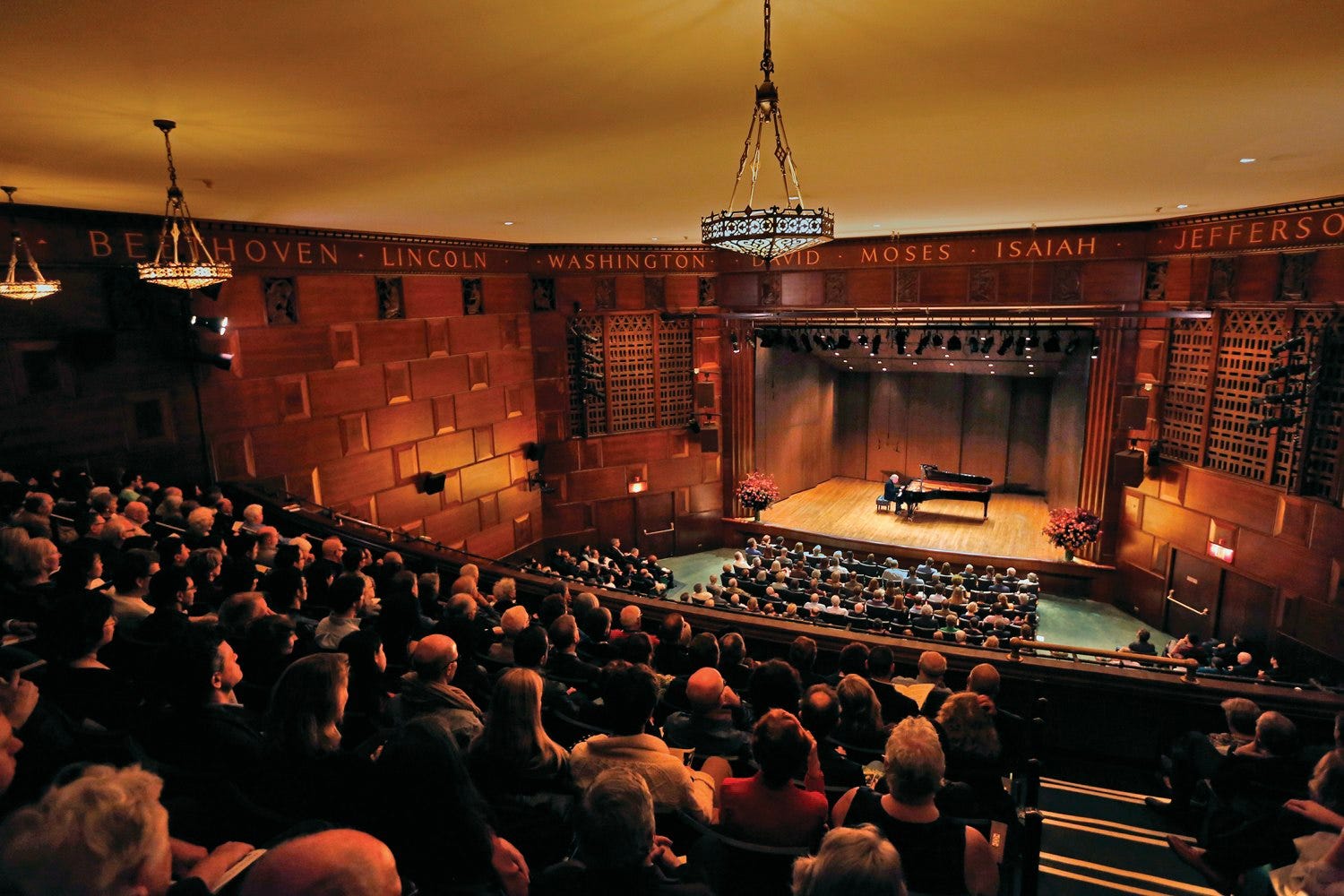
Today I wanted to share a special Q&A I did with the good people at the 92nd Street Y in Manhattan — home to the historic room where I’ll be launching MAN IN THE MIRROR into the world next Wednesday.
The book I’ve written was first a conversation the internet showed itself incapable of having. Now, as I launch the book in that storied room, and then in rooms across the length and breadth of this country, I want us to have the conversations the internet couldn’t. Conversations that feel like the opposite of the clickbait all around us. Conversations that are human in the age of AI. Conversations that are life-giving, about how can build the kinds of communities where we all feel like we belong.
I’m so eager to meet so many of you along the way. Join us at the 92nd Street Y if you’re in or around New York, or sign up to join us virtually from anywhere else:
And I’m very possibly coming to your city. Come meet me along the book tour trail:
If you haven’t yet, consider ordering the book, so we can all read it together:
And now on to my conversation with Daniel Poppick.
Anand Giridharadas Holds Up the Mirror
Reposted from the original here.
The tragic story of Jordan Neely’s death on the subway and Daniel Penny’s subsequent trial for manslaughter and negligent homicide — and Penny’s ultimate acquittal — divided New York City, and much of the country. In your book, you make the case that the polarized reaction elides a deeper moral complexity. What have we been missing?
Part of why I am excited to be launching this book in that historic room at 92NY is that this was a conversation that the internet couldn’t have. The case of Jordan Neely and Daniel Penny was on the simplest level the case of a tragic and fatal encounter on an uptown F train. But as every New Yorker who reads this will know, every subway car fits more than people — it contains clashing histories and social forces. There was a lot of institutional failure in the life of Jordan Neely, a former Michael Jackson impersonator who was homeless and mentally ill; there has also been an implicit permission of violence in the air since the beginning of the Trump era. Once the internet got hold of the story of this encounter, it was reduced to clickbait, hot takes, and a kind of American Rorschach test that quickly became almost tribal.
I wrote a book in a very different spirit. In Man in the Mirror, I am trying to understand what actually happened, and I am trying to imagine a city and a country and a world in which Daniel Penny felt neither the need nor the right to take someone’s life. It is a story, more than anything else I’ve ever written about in my life, of deep moral complexity; of genuinely difficult dilemmas about how to care for the most precarious and vulnerable people in our society, and how to make people feel safe in public space without deploying police as a tool for everything. I wanted to launch this book in that historic room at 92NY because it is place that is famous for having hard conversations that couldn’t happen elsewhere. My hope is that we’re going to be able to gather on September 30th and have a conversation that is the opposite of clickbait.
What is it about 92NY and its audience that you think makes this conversation possible here?
Over the years I’ve heard from people who are older than me that 92NY is like an intellectual grocery store. It isn’t a place you visit twice a year when something piques your interest — it’s a place you visit twice a week because you want to refresh and restock your ideas about the world. There’s an infinite library of content on the internet, but 92NY has this community that keeps wanting to leave the house to go sit with other people to take in ideas. That is a profoundly civic faith that is sadly rare. I do think it has a good chance of coming back, but the burden is not just on the creators — it is on the audience to stay engaged. I think the audience at 92NY understands that.
You are known as a journalist, but Man in the Mirror is written in a more narrative style than your last few books — it is almost novelistic, reaching into the literary lineage of books like Truman Capote’s In Cold Blood, which had its public debut on our stage. Why was it important for you to tell this story in this way?
I have always wanted to write this kind of book. In my previous books, I was trying to articulate an idea. My book Winners Take All from 2018 is very much in that spirit — it is not meant to be a beautiful work of art, it’s trying to articulate an idea and deliver it to a reader. With this book, I wanted to make something that was a piece of art that also happened to be non-fiction. There is a branch of journalism in this tradition: books like Capote’s In Cold Blood, Adrian LeBlanc’s Random Family, and George Packer’s The Unwinding. It is very hard to write a book with an imaginative quality that is also documented and true.
It seems to me that there is a crisis of both trust and attention in our culture. At its best, narrative non-fiction attempts to solve the problem of trust through journalistic rigor, and it addresses the problem of attention through a commitment to engaging storytelling. I wanted to write a riveting story in which I could show my receipts to prove its truth.
Winners Take All was an investigation into how the global elite’s efforts to “change the world” preserved and deepened a status quo of inequality. In a sense, Man in the Mirror could be read as a companion to that book, the other side of the same coin. What is the relationship between the inequality that you wrote about in 2018 and Neely’s story?
Great question. The Neely and Penny case reveals, in my view, the defining political emotion of our age: the feeling of abandonment. At a time when the richest and most powerful people in the world are building bunkers, buying private islands, and seeking immortality while telling the rest of us that AI is going to kill humanity, most of us have been left to fend for ourselves. In the subway car in which Jordan Neely was killed, there was one emotion that virtually all the passengers had in common: the feeling that no one was coming to save them. I would argue that this emotion was not just present in that one subway car. I think it’s everywhere in our culture. Man in the Mirror is a kind of follow-up story to what I was writing about in Winners Take All— a story about what happens when people are left to fend for themselves.
It’s been more than three years since Neely’s death and nearly two years since Penny’s trial. Have these events changed life in New York City?
It became very clear to me while reporting this book that people who are chronically homeless and mentally ill, of which there are many in America’s cities right now, are falling into a chasm. It is a chasm between a view of the world held by some progressives that overestimates the capacity for this population’s autonomy and a right-wing view of the world that doesn’t want to spend a dime on a system of care for people who need help, that wants people like this to be swept away. The tragedy of Neely’s death on the subway held up a mirror to our society, but so far it has not resulted in reforms.
At your event at 92NY, you’ll be talking to Tina Brown. Why was it important for you to have this conversation with her in particular?
Tina is one of the greatest editors around, and she’s someone who deeply understands many of the issues at the heart of this book. She understands New York deeply, she understands the crisis of mental health in our society, and she understands the problem of media sensationalism in how we process a story like the one I’m trying to tell. She has a combination of journalistic rigor and an understanding of the attention economy which is rare, and it’s something I aspire to.
What do you hope the audience takes away with them after this event?
You mentioned Truman Capote’s book debuting on that stage — I find that daunting, but I am moved to be part of that tradition, along with all the other 92NY conversations that I’ve seen, heard, and read about. My first hope is that this is going to be an electric night in New York. We’re going to sit together and ask a big question: how do we live together? How do we all find a shared sense of belonging? There is so much loneliness, isolation, and estrangement across this city. I think it’s time for New Yorkers to grapple with this story’s many realities and meanings and take it forward for themselves so that we can make the city better. I deeply believe that this kind of conversation actually can help build a new city. I couldn’t be more honored to be starting it on that stage.
Anand Giridharadas launches Man in the Mirror with Tina Brown on Wed, Sep 30.
It’s hard to tell from this interview how even-handed your book will be. Here you seem mostly concerned about Neely’s real vulnerability. As I understand it (and I may not), Penny wasn’t trying to kill Neely. He was trying to fill that void of common trust and safety you talk about by retraining Neely to protect the people who felt threatened by Neely’s behavior. Hopefully you have told both sides of the story.
“Corruption begins in lack of relationship.” Jiddu Krishnamurti at NY’s Town Hall, 1973.
I preordered your book and can’t wait to read it. You are one of my favorite writers and I must say that, for me, “India Calling” was very much like reading a novel. I think I’ve mentioned before that I wrote about your writing and the way in which you were one of a handful of people who pulled me out of a debilitating depression when I couldn’t bear the destruction of our home, our earth.
It’s called “Tweeting The Pope”
Here’s the link:
https://alexiskelley.substack.com/p/tweeting-the-pope-how-twitter-saved-me?r=1emaw&utm_campaign=post&utm_medium=web